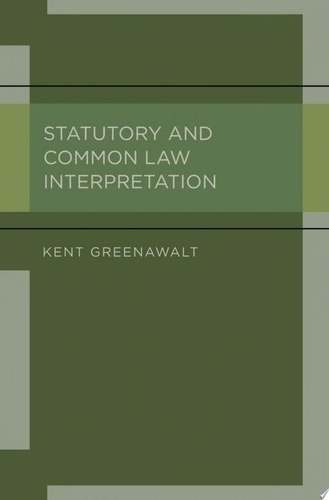
Statutory and Common Law Interpretation
0
0
As an Amazon Associate and affiliate partner, Menrva Books earns from qualifying purchases. Learn more
Author Description
As Kent Greenwalt's second volume on aspects of legal interpretation, this book analyzes statutory and common law interpretation and compares the two. In respect to statutory interpretation, it first asks whether judges are "faithful agents" of the legislature or "independent cooperative partners." It concludes that the obvious answer is that neither simple categorization really fits-that the function of judges involves a combination of roles. The next issue addressed is whether the intent of those in authority matters for interpreting the kinds of instructions contained in statutes. At the general level, the answer is "yes." This answer follows even if one thinks interpretation should concentrate on the understanding of readers, because readers themselves would treat intentions as part of the relevant context of the language of statutes. It would take some special reasons, such as constitutional structure or unreliability, to discount actual intents of legislators and use of legislative history. The book argues that none of these special reasons are convincing. On the question whether judges should focus on the language of specific provision or overall purpose, both are relevant, and purpose should become more important as time passes. In an analysis of various other features of statutory interpretation, the book claims that presidential signing statements should not have weight, that subsequent legislative actions short of new statutes should only occasionally carry importance, that "canons of interpretation," such as the rule of lenity, can provide some, limited, guidance, and that there are special reasons for courts to adhere to precedents in statutory cases, but these should not yield any absolute rule. A chapter on administrative interpretation of statutes claims that the standards agencies apply should differ to a degree from those of courts and that judicial deference to those interpretations is ordinarily warranted.The book's second part, on common law int
Menrva's Summary
THE THESIS
This book investigates the fundamental methodologies and philosophical underpinnings governing how judges interpret statutory and common law. Kent Greenawalt, a distinguished legal scholar, evaluates the tension between judicial roles as faithful agents of the legislature versus independent cooperative partners. By examining the relevance of legislative intent, the weight of administrative interpretations, and the application of canons of construction, the author constructs a framework for understanding how legal meaning is derived and applied in contemporary courts.
THE SCOPE MAP
What You Will Find
- Comparative analysis of statutory interpretation versus common law adjudication.
- Evaluation of the role of legislative intent and legislative history in judicial decision-making.
- Examination of administrative deference and the weight of presidential signing statements.
- Discussion on the application of canons of interpretation and the principle of stare decisis.
THE AUTHORITY PERSPECTIVE
Legal scholars and practitioners frequently cite this work as a rigorous, nuanced exploration of the complexities inherent in judicial interpretation. The text is recognized for its academic density and its balanced approach to long-standing debates within the field of jurisprudence.
Page Count:
408
Publication Date:
2012-11-12
Publisher:
Oxford University Press
ISBN-10:
0199756147
ISBN-13:
9780199756148
Law
Jurisprudence
Common Law
Interpretation and construction
Legal Theory
Community Tags
Other Editions(2)
Similar Books






Reader Comments
Share Your Thoughts
No comments yet. Be the first to share your thoughts!