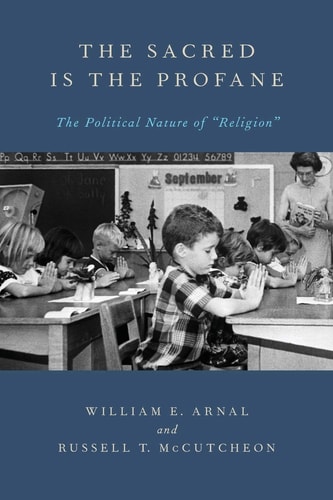
The Sacred Is the Profane: The Political Nature of "Religion"
0
0
As an Amazon Associate and affiliate partner, Menrva Books earns from qualifying purchases. Learn more
Author Description
The Sacred Is the Profane collects nine essays written over several years by William Arnal and Russell T. McCutcheon that share a convergent perspective: not simply that both the category and concept "religion" is a construct, something that we cannot assume to be "natural" or universal, but also that the ability to think and act "religiously" is, quite specifically, a modern, political category in its origins and effects, the mere by-product of the modern state.These collected essays, substantially rewritten for this volume, advance current scholarly debates on secularism-debates which, the authors argue, insufficiently theorize the sacred/secular, church/state, and private/public binaries by presupposing religion (often under the guise of such terms as "religiosity," "faith," or "spirituality") to historically precede the nation-state. The essays return, again and again, to the question of what "religion"--word and concept--accomplishes, now, for those who employ it, whether at the popular, political, or scholarly level. The focus here for two writers from seemingly different fields is on the efficacy, costs, and the tactical work carried out by dividing the world between religious and political, church and state, sacred and profane.
Menrva's Summary
THE THESIS
This collection of essays investigates the core question of whether the category of "religion" is a natural, universal phenomenon or a constructed political tool of the modern state. Authors William Arnal and Russell T. McCutcheon, both established scholars in the study of religion, argue that the binary division between the sacred and the profane is a tactical maneuver used to legitimize modern political structures. By examining how these concepts are deployed in contemporary discourse, the authors challenge the assumption that faith or spirituality exists independently of state-sanctioned frameworks.
THE SCOPE MAP
What You Will Find
- A critical analysis of the historical construction of the "religion" category.
- Theoretical frameworks for deconstructing the church/state and public/private binaries.
- Case studies examining the tactical use of religious terminology in modern political rhetoric.
- An interrogation of how scholarly definitions of faith reinforce existing power structures.
THE AUTHORITY PERSPECTIVE
Experts in religious studies and political theory identify this work as a significant contribution to the critical study of secularism. Readers frequently note the academic density of the prose, which serves as a foundational text for those interested in the intersection of power, language, and institutional belief systems.
Page Count:
264
Publication Date:
2012-11-29
Publisher:
Oxford University Press
ISBN-10:
0199757127
ISBN-13:
9780199757121
Religion
Philosophy
Secularism
Sociology
Community Tags
Similar Books