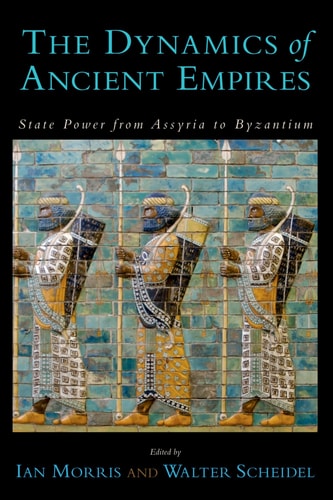
The Dynamics of Ancient Empires: State Power from Assyria to Byzantium
0
0
As an Amazon Associate and affiliate partner, Menrva Books earns from qualifying purchases. Learn more
Author Description
Transcending ethnic, linguistic, and religious boundaries, early empires shaped thousands of years of world history. Yet despite the global prominence of empire, individual cases are often studied in isolation. This series seeks to change the terms of the debate by promoting cross-cultural, comparative, and transdisciplinary perspectives on imperial state formation prior to the European colonial expansion.The world's first known empires took shape in Mesopotamia between the eastern shores of the Mediterranean Sea and the Persian Gulf, beginning around 2350 BCE. The next 2,500 years witnessed sustained imperial growth, bringing a growing share of humanity under the control of ever-fewer states. Two thousand years ago, just four major powers--the Roman, Parthian, Kushan, and Han empires--ruled perhaps two-thirds of the earth's entire population. Yet despite empires' prominence in the early history of civilization, there have been surprisingly few attempts to study the dynamics of ancient empires in the western Old World comparatively. Such grand comparisons were popular in the eighteenth century, but scholars then had only Greek and Latin literature and the Hebrew Bible as evidence, and necessarily framed the problem in different, more limited, terms. Near Eastern texts, and knowledge of their languages, only appeared in large amounts in the later nineteenth century. Neither Karl Marx nor Max Weber could make much use of this material, and not until the 1920s were there enough archaeological data to make syntheses of early European and west Asian history possible. But one consequence of the increase in empirical knowledge was that twentieth-century scholars generally defined the disciplinary and geographical boundaries of their specialties more narrowly than their Enlightenment predecessors had done, shying away from large questions and cross-cultural comparisons. As a result, Greek and Roman empires have largely been studied in isolation from those of the Near East.
Menrva's Summary
THE THESIS
This volume investigates the structural mechanisms and comparative dynamics that facilitated the formation and maintenance of ancient empires from the Assyrian period through the Byzantine era. Editors Ian Morris and Walter Scheidel, both distinguished scholars in history and classics, assemble a multidisciplinary team to challenge the tendency of modern academia to study imperial states in isolation. By synthesizing archaeological data, linguistic evidence, and historical records, the authors argue that early empires followed identifiable patterns of state power that transcended specific ethnic or religious boundaries.
THE SCOPE MAP
What You Will Find
- Comparative analysis of imperial state formation across the Near East and the Mediterranean.
- Examination of the transition from early Mesopotamian states to the Roman and Byzantine systems.
- Integration of archaeological evidence with traditional textual sources like Greek, Latin, and Near Eastern literature.
- Theoretical frameworks for understanding the concentration of power and population control in antiquity.
THE AUTHORITY PERSPECTIVE
Experts recognize this work as a significant contribution to the field of comparative history, noting its success in bridging the gap between Near Eastern and Greco-Roman studies. Readers frequently highlight the academic density of the prose, which serves as a foundational text for students and researchers interested in the long-term evolution of state power.
Page Count:
400
Publication Date:
2010-11-04
Publisher:
Oxford University Press
ISBN-10:
0199758344
ISBN-13:
9780199758340
History
Sociology
State The
Archaeology
Ancient History
Community Tags
Similar Books


Reader Comments
Share Your Thoughts
No comments yet. Be the first to share your thoughts!