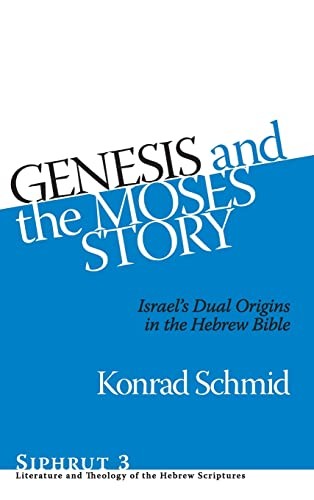
Genesis and the Moses Story
0
0
As an Amazon Associate and affiliate partner, Menrva Books earns from qualifying purchases. Learn more
Author Description
Konrad Schmid is a Swiss biblical scholar who belongs to a larger group of Continental researchers proposing new directions in the study of the Pentateuch. In this volume, a translation of his Erzväter und Exodus, Schmid argues that the ancestor tradition in Genesis and the Moses story in Exodus were two competing traditions of Israel's origins and were not combined until the time of the Priestly Code--that is, the early Persian period. Schmid interacts with the long tradition of European scholarship on the Hebrew Bible but departs from some of the main tenets of the Documentary Hypothesis: he argues that the pre-Priestly material in both text blocks is literarily and theologically so divergent that their present linkage is more appropriately interpreted as the result of a secondary redaction than as thematic variation stemming from J's oral prehistory. He dates Genesis-2 Kings to the Persian period and considers it a redactional work that, in its present shape, is a historical introduction to the message of future hope presented in the prophetic corpus of Isaiah-Malachi.
Menrva's Summary
THE THESIS
The book investigates the competing origins of Israelite identity as presented in the traditions of Genesis and Exodus. Konrad Schmid, a Swiss biblical scholar, posits that the ancestor traditions within Genesis and the Moses story in Exodus were initially separate and competing narratives of Israel's origins. He argues that these traditions were not unified until the era of the Priestly Code during the early Persian period. Schmid engages with established European scholarship on the Hebrew Bible but challenges key aspects of the Documentary Hypothesis, proposing that the pre-Priestly material in both Genesis and Exodus is too divergent to stem from a single oral prehistory.
THE SCOPE MAP
- Analysis of the ancestor traditions in the Book of Genesis.
- Examination of the Moses story in the Book of Exodus.
- Argument for the late combination of Genesis and Exodus traditions.
- Critique of the Documentary Hypothesis and its application to the Pentateuch.
- Dating of Genesis-2 Kings to the Persian period.
- Interpretation of Genesis-2 Kings as a historical introduction to the prophetic corpus.
- Discussion of the Priestly Code's role in unifying origin narratives.
THE AUTHORITY PERSPECTIVE
The book is presented as a significant contribution to Pentateuchal studies by a prominent Continental researcher. Schmid's work engages deeply with existing scholarship, offering a nuanced perspective on the formation of the earliest biblical texts. The analysis challenges traditional views on the unity of the Pentateuch, proposing a later redactional stage for the combined narratives. This approach is likely to be of interest to scholars and students of the Hebrew Bible and ancient Israelite history.
Page Count:
456
Publication Date:
2010-01-01
ISBN-10:
157506152X
ISBN-13:
9781575061528
Non-Fiction
History
Ancient History
Community Tags
Similar Books