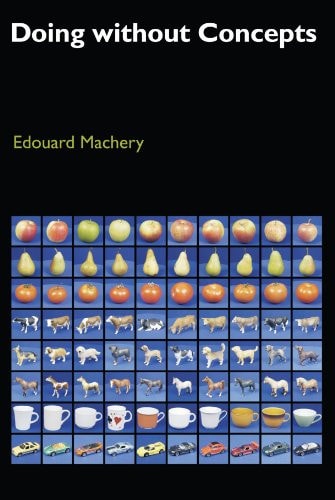
Doing without Concepts
0
0
As an Amazon Associate and affiliate partner, Menrva Books earns from qualifying purchases. Learn more
Author Description
Over recent years, the psychology of concepts has been rejuvenated by new work on prototypes, inventive ideas on causal cognition, the development of neo-empiricist theories of concepts, and the inputs of the budding neuropsychology of concepts. But our empirical knowledge about concepts has yet to be organized in a coherent framework.In Doing without Concepts, Edouard Machery argues that the dominant psychological theories of concepts fail to provide such a framework and that drastic conceptual changes are required to make sense of the research on concepts in psychology and neuropsychology. Machery shows that the class of concepts divides into several distinct kinds that have little in common with one another and that for this very reason, it is a mistake to attempt to encompass all known phenomena within a single theory of concepts. In brief, concepts are not a natural kind. Machery concludes that the theoretical notion of concept should be eliminated from the theoretical apparatus of contemporary psychology and should be replaced with theoretical notions that are more appropriate for fulfilling psychologists' goals. The notion of concept has encouraged psychologists to believe that a single theory of concepts could be developed, leading to useless theoretical controversies between the dominant paradigms of concepts. Keeping this notion would slow down, and maybe prevent, the development of a more adequate classification and would overshadow the theoretical and empirical issues that are raised by this more adequate classification. Anyone interested in cognitive science's emerging view of the mind will find Machery's provocative ideas of interest.
Menrva's Summary
THE THESIS
Edouard Machery investigates whether the traditional psychological notion of a 'concept' remains a viable or useful theoretical construct in contemporary cognitive science. Machery, a philosopher of science and cognitive scientist, evaluates existing research on prototypes, causal cognition, and neo-empiricist theories. He argues that because the phenomena currently grouped under the label of 'concepts' are heterogeneous and lack a unified underlying structure, the term itself should be eliminated from psychological discourse to prevent unproductive theoretical debates.
THE SCOPE MAP
What You Will Find
- A critical review of dominant psychological theories regarding categorization and mental representation.
- An analysis of the neuropsychological evidence concerning how the brain processes different types of information.
- A philosophical argument for the elimination of 'concept' as a natural kind in scientific taxonomy.
- A proposed framework for replacing monolithic conceptual theories with more granular, domain-specific classifications.
THE AUTHORITY PERSPECTIVE
Experts and reviewers in the fields of philosophy and cognitive science recognize this work as a significant, albeit provocative, challenge to established paradigms. Readers frequently note the academic density of the prose, which serves as a rigorous examination of the limitations inherent in current psychological terminology.
Page Count:
296
Publication Date:
2011-07-18
Publisher:
Oxford University Press
ISBN-10:
0199837562
ISBN-13:
9780199837564
Philosophy
Psychology
History & Surveys
Concepts
Mind & Body
Community Tags
Other Editions(2)
Similar Books