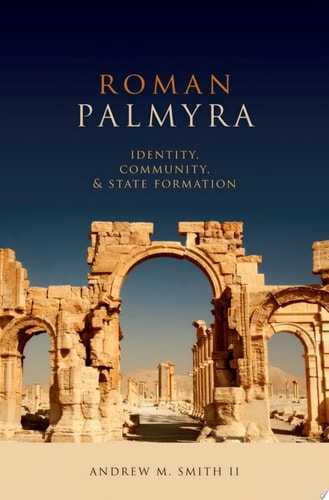
Roman Palmyra: Identity, Community, and State Formation
0
0
As an Amazon Associate and affiliate partner, Menrva Books earns from qualifying purchases. Learn more
Author Description
In social, economic, and cultural terms, the eastern frontier of the Roman Empire was vastly complex, which has fueled considerable debate among scholars concerning the nature of the interactions between Romans and natives in the Near East. Notions of imperialism, specifically "cultural" imperialism, frame much of the debate. Through a detailed analysis of Palmyrene identity and community formation, Andrew M. Smith II presents a social and political history of Roman Palmyra, the oasis city situated deep in the Syrian Desert midway between Damascus and the Euphrates river. This city-state is unique in the ancient world, since it began as a humble community, probably no more than an isolated village, and grew--due in part to its role in the caravan trade--into an economically powerful, cosmopolitan urban center of Graeco-Roman character that operated outside of Roman rule, yet under Roman patronage. The book therefore focuses on two aspects of Palmyrene civilization during the first three centuries of the Common Era: the emergence and subsequent development of Palmyra as a commercial and political center in the desert frontier between Rome and Parthia (and later Persia), and the "making" of Palmyrenes. This study is thus concerned with the creation, structure, and maintenance of Palmyrene identity and that of Palmyra as an urban community in a volatile frontier zone. The history of Palmyra's communal development would be wholly obscure were it not for the archaeological and epigraphic materials that testify to Palmyrene achievements and prosperity at home and abroad. These, complemented by the literary evidence, also provide insight into the relatively obscure historical process of sedentarization and of the relationships between pastoral and sedentary communities in the Roman Near East. In addition to examining Palmyra as a frontier community, the book will move beyond Syria to explore the development and maintenance of Palmyrene identity in diaspora settings in Italy.
Menrva's Summary
THE THESIS
How did the oasis city of Palmyra navigate its unique position as a cosmopolitan commercial hub while balancing the competing influences of the Roman Empire and local Near Eastern traditions? Andrew M. Smith II, a scholar of the ancient Near East, utilizes archaeological, epigraphic, and literary evidence to reconstruct the social and political evolution of Palmyra during the first three centuries of the Common Era. The work argues that Palmyrene identity was not a static construct but a fluid, adaptive process shaped by the city's role in the caravan trade and its status as a semi-autonomous entity under Roman patronage.
THE SCOPE MAP
What You Will Find
- Analysis of the transition from an isolated village to a major urban center.
- Examination of the relationship between pastoral and sedentary populations in the Syrian Desert.
- Investigation of Palmyrene identity formation within both the home city and diaspora settings in Italy.
- Synthesis of archaeological findings and epigraphic records to document economic and political structures.
THE AUTHORITY PERSPECTIVE
Scholars recognize this work as a significant contribution to the study of frontier dynamics and identity in the Roman Near East. Readers frequently note the academic density of the prose, which relies heavily on specialized archaeological and historical data to support its arguments.
Page Count:
320
Publication Date:
2013-02-01
Publisher:
Oxford University Press
ISBN-10:
0199861102
ISBN-13:
9780199861101
History
Middle East
Community Life
Social change
Sociology
Archaeology
Ancient History
Group Identity
Syria history
Politics & Government
Roman Empire
Community Tags
Similar Books