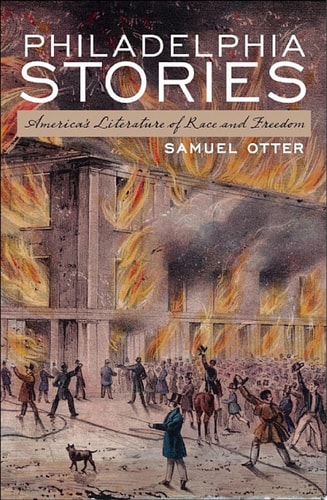
Philadelphia Stories: America's Literature of Race and Freedom
0
0
As an Amazon Associate and affiliate partner, Menrva Books earns from qualifying purchases. Learn more
Author Description
In Philadelphia Stories, Samuel Otter finds literary value, historical significance, and political urgency in a sequence of texts written in and about Philadelphia between the Constitution and the Civil War. Historians such as Gary B. Nash and Julie Winch have chronicled the distinctive social and political space of early national Philadelphia. Yet while individual writers such as Charles Brockden Brown, Edgar Allan Poe, and George Lippard have been linked to Philadelphia, no sustained attempt has been made to understand these figures, and many others, as writing in a tradition tied to the city's history. The site of William Penn's "Holy Experiment" in religious toleration and representative government and of national Declaration and Constitution, near the border between slavery and freedom, Philadelphia was home to one of the largest and most influential "free" African American communities in the United States. The city was seen by residents and observers as the laboratory for a social experiment with international consequences. Philadelphia would be the stage on which racial character would be tested and a possible future for the United States after slavery would be played out. It would be the arena in which various residents would or would not demonstrate their capacities to participate in the nation's civic and political life. Otter argues that the Philadelphia "experiment" (the term used in the nineteenth-century) produced a largely unacknowledged literary tradition of peculiar forms and intensities, in which verbal performance and social behavior assumed the weight of race and nation.
Menrva's Summary
THE THESIS
This book investigates the unacknowledged literary tradition emerging from Philadelphia between the ratification of the Constitution and the onset of the Civil War, questioning how the city's unique social experiment shaped American concepts of race and citizenship. Samuel Otter, a scholar of American literature, utilizes a wide array of primary texts and historical context to argue that Philadelphia served as a critical laboratory for testing racial character and civic participation. He posits that the city's proximity to the border of slavery and freedom created a distinct, intense literary tradition where writing functioned as a form of social and political performance. By examining the works of authors like Charles Brockden Brown, Edgar Allan Poe, and George Lippard, Otter demonstrates how the city's specific history of religious and political experimentation influenced the development of national identity.
THE SCOPE MAP
What You Will Find
- Analysis of literary works produced in Philadelphia from the late 18th century to the mid-19th century.
- Examination of the intersection between the city's history of religious toleration and its racial politics.
- Case studies of prominent writers including Charles Brockden Brown, Edgar Allan Poe, and George Lippard.
- Exploration of the "Philadelphia experiment" as a framework for understanding national debates on slavery and freedom.
THE AUTHORITY PERSPECTIVE
Scholars and historians recognize this work as a significant contribution to the study of regional literary traditions and their impact on national discourse. Readers frequently note the academic density of the prose, which provides a rigorous analysis of how urban environments influence the development of political and social thought.
Page Count:
410
Publication Date:
2013-01-01
Publisher:
Oxford University Press
ISBN-10:
0199889619
ISBN-13:
9780199889617
History
American Studies
United States
Literary Criticism
Cultural History
English & College Success
English
Community Tags
Similar Books