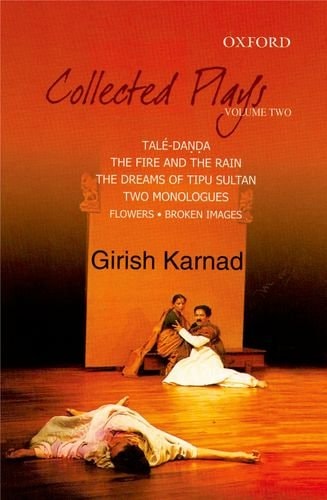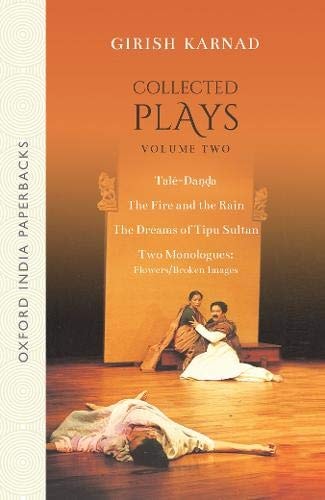
Collected Plays: Volume 2
0
0
As an Amazon Associate and affiliate partner, Menrva Books earns from qualifying purchases. Learn more
Author Description
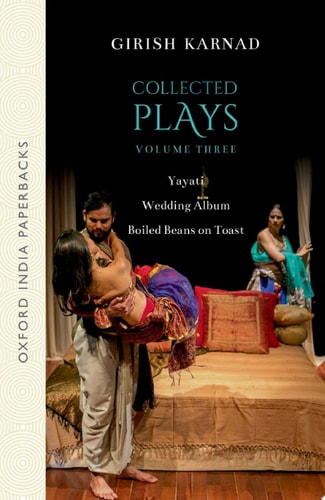
Th e troubled reign of a fourteenth-century sultan of Delhi helps dramatizethe crisis of secular nationhood in post-Independence India. A twelft hcenturyfolktale about 'transposed heads' offers a path-breaking model fora quintessentially 'Indian' theatre in postcolonial times. The folktale abouta woman with a snake lover explores gender relations within marriage.Individual human sexuality meets the historical debate on violence in Indianculture. The plays in this volume span roughly the first half of the career ofGirish Karnad, one of India's pre-eminent playwrights.The three-volume set of Karnad's Collected Plays brings together Englishversions of his important works. Each volume contains an extensiveintroduction by theatre scholar Aparna Bhargava Dharwadker, Professorof English and Interdisciplinary Theatre Studies, University of Wisconsin,Madison. The introductions trace the literary and theatrical evolution ofKarnad's work over six decades and position it in the larger context ofmodern Indian drama. In addition, they comment on Karnad's place as authorand translator in a multilingual performance culture and the relation of hisplaywriting to his work in the popular media.
Menrva's Summary
THE PULSE
Girish Karnad’s dramatic works navigate the intersection of historical power, mythological archetypes, and the complexities of postcolonial identity. Through a series of plays, the author examines the tension between individual desire and societal expectations, utilizing both classical folklore and historical narratives to critique modern Indian life. The collection employs diverse structural frameworks, ranging from historical allegory to surrealist explorations of human relationships, all while maintaining a focus on the performative nature of cultural identity. The narrative voice shifts between the rigid constraints of historical record and the fluid, symbolic logic of traditional Indian storytelling.
INSIDE THE PAGES
- Exploration of fourteenth-century political instability as an allegory for modern secularism
- Adaptation of classical folktales to establish a distinct postcolonial theatrical model
- Examination of gender dynamics and marital expectations through mythological motifs
- Integration of human sexuality with broader cultural debates on violence
- Analysis of the author's dual role as both playwright and translator
- Contextualization of works within a multilingual performance culture
- Scholarly introductions by Aparna Bhargava Dharwadker detailing theatrical evolution
- Synthesis of literary history and interdisciplinary theatre studies
THE COLLECTIVE ECHO
Discussion often centers on Karnad’s ability to bridge the gap between ancient Indian traditions and contemporary dramatic forms. Readers frequently highlight the intellectual rigor present in his reinterpretation of historical figures and mythological tropes. Critics emphasize the effectiveness of his work in challenging established norms regarding gender and political authority within the Indian context. The inclusion of scholarly introductions provides a framework that allows readers to appreciate the broader evolution of his career over several decades. This volume is widely regarded as a significant contribution to the study of modern Indian drama and its place in global literature.
Page Count:
344
Publication Date:
2021-01-26
Publisher:
Oxford University Press
ISBN-10:
0190127686
ISBN-13:
9780190127688
Drama
Indian
Plays
Theater Studies
Postcolonial
Community Tags
Similar Books