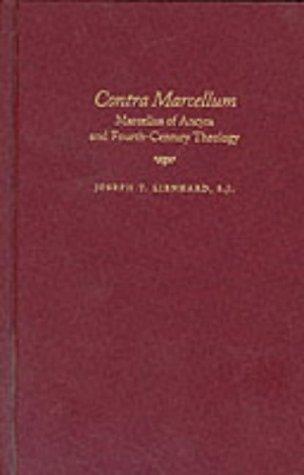
Contra Marcellum
0
0
As an Amazon Associate and affiliate partner, Menrva Books earns from qualifying purchases. Learn more
Author Description
Marcellus of Ancyra (ca. 285-374) was a controversial figure in the Trinitarian debate after Nicaea. He has often been written off as the odd heretic who misunderstood the teaching of the Council of Nicaea and taught that the Godhead temporarily expanded into a Dyad, and then into a Triad, but would, at the end of time, contract once again to a Monad. In other words, he supposedly taught that the Trinity was a temporary phenomenon. But, according to the author of this volume, Marcellus was not primarily concerned with speculation on the Trinity; rather his concern was with monotheism, and with the full humanity of Christ. Here, Joseph T. Lienhard, S.J., studies the so-called Arian controversy of the fourth century from one well-defined angle: Marcellus and his influence. The book shows that Marcellus, far from being isolated, was part of a larger theological tendency. Among those who sympathized with him were Athanasius of Alexandria, much of the western church, and bishops in Asia Minor and Egypt. Lienhard begins by studying Marcellus's life and the history of modern scholarship on Marcellus. He then examines the Arian controversy in terms of two theological systems in conflict, called "miahypostatic theology" and "dyohypostatic theology," depending on whether a system held that God is best called one hypostasis or two. Lienhard provides a complete analysis of Marcellus's theology, using only the certainly authentic works of his that survive, and traces the reactions to his teaching-from those who remained sympathetic to him, to those who rejected his theology outright, and finally to those who partially accepted his theses. This book is part of a larger project among scholars to reexamine and rewrite the history of the Arian controversy in the fourth century.
Menrva's Summary
THE THESIS
The book re-examines the controversial Trinitarian figure Marcellus of Ancyra and his influence on the post-Nicene Arian controversy. Joseph T. Lienhard challenges the traditional view of Marcellus as a heretic who misunderstood the Council of Nicaea, arguing instead that Marcellus's primary concerns were monotheism and the full humanity of Christ. The study positions Marcellus not as an isolated figure but as part of a broader theological movement that found sympathy among prominent figures like Athanasius of Alexandria and many bishops in the Western church, Asia Minor, and Egypt. Lienhard analyzes Marcellus's theology using only his authentic surviving works, tracing the diverse reactions to his teachings from supporters to outright rejecters.
THE SCOPE MAP
- Biographical and historical overview of Marcellus of Ancyra (ca. 285-374).
- Analysis of modern scholarship on Marcellus.
- Examination of the Arian controversy through the lens of 'miahypostatic' and 'dyohypostatic' theological systems.
- Complete analysis of Marcellus's theology based on his authentic works.
- Tracing of reactions to Marcellus's teaching, from sympathy to rejection.
- Contextualization of Marcellus within a larger theological tendency of the fourth century.
THE AUTHORITY PERSPECTIVE
This volume offers a significant reevaluation of Marcellus of Ancyra, moving beyond the traditional portrayal of him as a heretical outlier in the Trinitarian debates. The author's detailed analysis, grounded in Marcellus's authentic writings, suggests a more nuanced understanding of his theological motivations, emphasizing his commitment to monotheism and Christ's full humanity. By situating Marcellus within a broader theological current, the book aims to revise the historical narrative of the Arian controversy, highlighting his connections with influential figures and churches of the era. The work is presented as part of a larger scholarly effort to reconstruct the history of this pivotal period in Christian thought.
Page Count:
280
Publication Date:
1999-01-01
ISBN-10:
0813209013
Non-Fiction
History
Theology
Ancient History
Church History
Community Tags
Similar Books