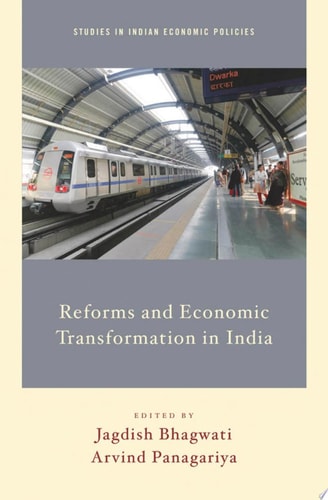
Reforms and Economic Transformation in India
0
0
As an Amazon Associate and affiliate partner, Menrva Books earns from qualifying purchases. Learn more
Author Description
Reforms And Economic Transformation In India Is The Second Volume In The Series Studies In Indian Economic Policies. The First Volume, India's Reforms: How They Produced Inclusive Growth (oup, 2012), Systematically Demonstrated That Reforms-led Growth In India Led To Reduced Poverty Among All Social Groups. They Also Led To Shifts In Attitudes Whereby Citizens Overwhelmingly Acknowledge The Benefits That Accelerated Growth Has Brought Them And As Voters, They Now Reward The Governments That Deliver Superior Economic Outcomes And Punish Those That Fail To Do So. This Latest Volume Takes As Its Starting Point The Fact That While Reforms Have Undoubtedly Delivered In Terms Of Poverty Reduction And Associated Social Objectives, The Impact Has Not Been As Substantial As Seen In Other Reform-oriented Economies Such As South Korea And Taiwan In The 1960s And 1970s, And More Recently, In China. The Overarching Hypothesis Of The Volume Is That The Smaller Reduction In Poverty Has Been The Result Of Slower Transformation Of The Economy From A Primarily Agrarian To A Modern, Industrial One. Even As The Gdp Share Of Agriculture Has Seen Rapid Decline, Its Employment Share Has Declined Very Gradually. More Than Half Of The Workforce In India Still Remains In Agriculture. In Addition, Non-farm Workers Are Overwhelmingly In The Informal Sector. Against This Background, The Nine Original Essays By Eminent Economists Pursue Three Broad Themes Using Firm Level Data In Both Industry And Services. The Papers In Part I Ask Why The Transformation In India Has Been Slow In Terms Of The Movement Of Workers Out Of Agriculture, Into Industry And Services, And From Informal To Formal Employment. They Address What India Needs To Do To Speed Up This Transformation. They Specifically Show That Severe Labor-market Distortions And Policy Bias Against Large Firms Has Been A Key Factor Behind The Slow Transformation. The Papers In Part Ii Analyze The Transformation That Reforms Have Brought About Wi
Menrva's Summary
THE THESIS
This volume investigates why India's economic reforms have resulted in a slower transition from an agrarian-based economy to a modern industrial sector compared to other high-growth Asian economies. Edited by Jagdish N. Bhagwati, a prominent economist, the book compiles original research from leading scholars to analyze the structural barriers preventing the movement of labor from agriculture into formal industry and services. The authors utilize firm-level data to argue that labor-market distortions and policy biases against large-scale enterprises are the primary impediments to a more rapid economic transformation.
THE SCOPE MAP
What You Will Find
- Analysis of labor-market rigidities and their impact on employment shifts.
- Comparative studies between India's growth trajectory and the historical models of South Korea, Taiwan, and China.
- Empirical research using firm-level data across both the industrial and service sectors.
- Examination of the persistence of the informal sector in the Indian workforce.
THE AUTHORITY PERSPECTIVE
Experts recognize this volume as a significant contribution to the ongoing debate regarding the efficacy of Indian economic policy. The text is noted for its rigorous academic approach and is frequently cited by researchers examining the structural challenges of developing economies.
Page Count:
192
Publication Date:
2012-01-01
Publisher:
Oxford University Press, Incorporated
ISBN-10:
0199915210
ISBN-13:
9780199915217
History
Economics
India
Community Tags
Similar Books