
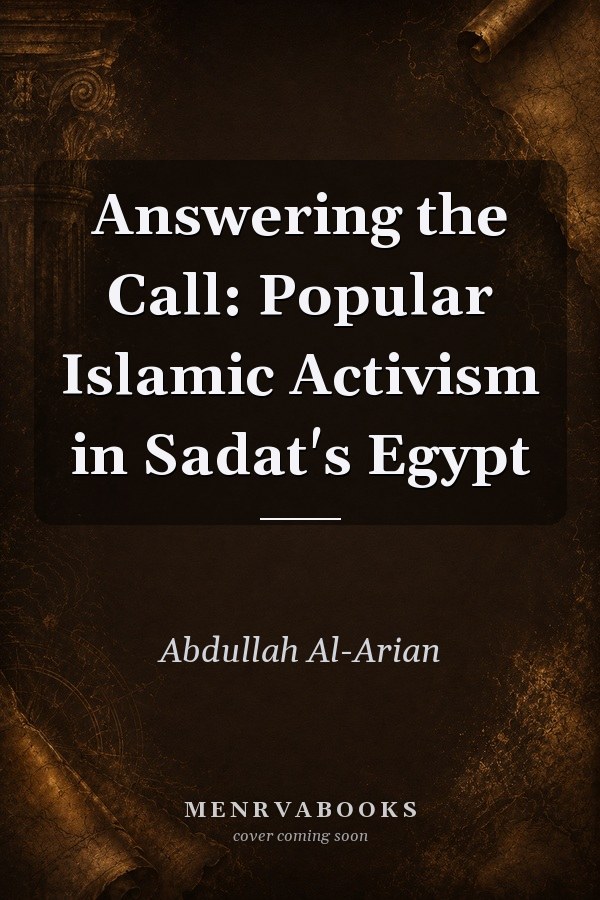
Answering the Call: Popular Islamic Activism in Sadat's Egypt
0
0
As an Amazon Associate and affiliate partner, Menrva Books earns from qualifying purchases. Learn more
Author Description
When revolutionary hero Gamal Abdel Nasser dismantled and suppressed Egypt's largest social movement organization during the 1950s, few could have imagined that the Muslim Brotherhood would not only reemerge, but could one day compete for the presidency in the nation's first ever democratic election. While there is no shortage of analyses of the Muslim Brotherhood's recent political successes and failures, no study has investigated the organization's triumphant return from the dustbin of history. Answering the Call examines the means by which the Muslim Brotherhood was reconstituted during Anwar al-Sadat's presidency. Through analysis of structural, ideological, and social developments during this period in the history of the Islamic movement, a more accurate picture of the so-called "Islamic resurgence" develops-one that represents the rebirth of an old idea in a new setting.The Muslim Brotherhood's success in rebuilding its organization rested in large part on its ability to attract a new generation of Islamic activists that had come to transform Egypt's colleges and universities into a hub for religious contention against the state. Led by groups such as al-Gama'ah al-Islamiyyah (The Islamic Society), the student movement exhibited a dynamic and vibrant culture of activism that found inspiration in a multitude of intellectual and organizational sources, of which the Muslim Brotherhood was only one.By the close of the 1970s, however, internal divisions over ideology and strategy led to the rise of factionalism within the student movement. A majority of student leaders opted to expand the scope of their activist mission by joining the Muslim Brotherhood, rejuvenating the struggling organization, and launching a new phase in its history.Answering the Call is an original study of the history of this dynamic and vibrant period of modern Egyptian history, giving readers a fresh understanding of one of Egypt's most pivotal eras.
Menrva's Summary
THE THESIS
This book investigates the mechanisms behind the resurgence of the Muslim Brotherhood in Egypt during the presidency of Anwar al-Sadat. Abdullah Al-Arian, a scholar of modern Middle Eastern history, utilizes archival research and historical analysis to challenge conventional narratives regarding the Islamic movement. He argues that the organization's revival was not an inevitable outcome but a result of specific structural and social shifts, particularly the mobilization of student activists within Egyptian universities during the 1970s.
THE SCOPE MAP
What You Will Find
- Historical analysis of the Egyptian student movement and the rise of al-Gama'ah al-Islamiyyah.
- Examination of the ideological and organizational transition of the Muslim Brotherhood during the Sadat era.
- Primary source research detailing the intersection of university campus politics and national religious activism.
- A framework for understanding how grassroots movements adapt to state suppression and political transformation.
THE AUTHORITY PERSPECTIVE
Experts recognize this work as a significant contribution to the study of modern Egyptian political history and the evolution of Islamic movements. Scholars frequently highlight the author's ability to synthesize complex social developments into a clear, academic narrative that clarifies the origins of contemporary political trends in the region.
Page Count:
320
Publication Date:
2014-01-01
Publisher:
Oxford University Press
ISBN-10:
0199931283
ISBN-13:
9780199931286
History
Religion
Egypt
Sociology
Middle Eastern
Community Tags
Other Editions(2)
Similar Books






Reader Comments
Share Your Thoughts
No comments yet. Be the first to share your thoughts!