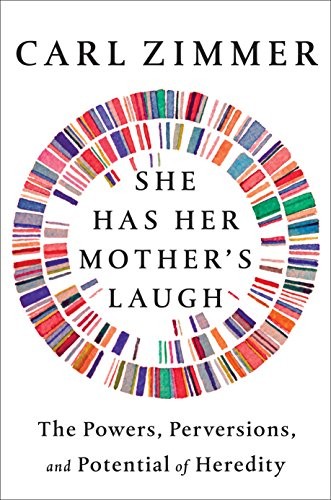
She Has Her Mother’s Laugh
0
0
As an Amazon Associate and affiliate partner, Menrva Books earns from qualifying purchases. Learn more
Author Description
Celebrated New York Times columnist and science writer Carl Zimmer presents a profoundly original perspective on what we pass along from generation to generation. Charles Darwin played a crucial part in turning heredity into a scientific question, and yet he failed spectacularly to answer it. The birth of genetics in the early 1900s seemed to do precisely that. Gradually, people translated their old notions about heredity into a language of genes. As the technology for studying genes became cheaper, millions of people ordered genetic tests to link themselves to missing parents, to distant ancestors, to ethnic identities... But, Zimmer writes, "Each of us carries an amalgam of fragments of DNA, stitched together from some of our many ancestors. Each piece has its own ancestry, traveling a different path back through human history. A particular fragment may sometimes be cause for worry, but most of our DNA influences who we are--our appearance, our height, our penchants--in inconceivably subtle ways." Heredity isn't just about genes that pass from parent to child. Heredity continues within our own bodies, as a single cell gives rise to trillions of cells that make up our bodies. We say we inherit genes from our ancestors--using a word that once referred to kingdoms and estates--but we inherit other things that matter as much or more to our lives, from microbes to technologies we use to make life more comfortable. We need a new definition of what heredity is and, through Carl Zimmer's lucid exposition and storytelling, this resounding tour de force delivers it. Weaving historical and current scientific research, his own experience with his two daughters, and the kind of original reporting expected of one of the world's best science journalists, Zimmer ultimately unpacks urgent bioethical quandaries arising from new biomedical technologies, but also long-standing presumptions about who we really are and what we can pass on to future generations.
Menrva's Summary
THE THESIS
Carl Zimmer redefines our understanding of heredity, moving beyond a purely genetic model to encompass the complex inheritance of microbes, technologies, and even subtle influences that shape who we are. The book explores how Charles Darwin initiated the scientific study of heredity but failed to fully answer its questions, and how the advent of genetics in the early 1900s provided a new framework. Zimmer highlights the modern trend of genetic testing for ancestry and identity, while also emphasizing that our inheritance is a mosaic of diverse ancestral fragments, each with its own history. He argues that heredity extends beyond genes to include the continuous processes within our bodies and the external factors we pass on, necessitating a broader definition of what it means to inherit.
THE SCOPE MAP
- Exploration of Charles Darwin's role in framing heredity as a scientific question.
- The development and impact of genetics in the early 20th century.
- The rise of genetic testing and its implications for personal identity and ancestry.
- A broader definition of heredity encompassing genes, microbes, and technology.
- The author's personal experiences with his daughters and their inheritance.
- Discussion of urgent bioethical quandaries arising from new biomedical technologies.
- Analysis of long-standing assumptions about identity and what we pass to future generations.
THE AUTHORITY PERSPECTIVE
Carl Zimmer's "She Has Her Mother's Laugh" is lauded for its profound originality and lucid exposition, offering a fresh perspective on heredity. Reviewers praise Zimmer's ability to weave together historical scientific research, current discoveries, and personal narrative to create a comprehensive understanding of what we inherit. The book is noted for its engaging storytelling, characteristic of one of the world's best science journalists, and its thoughtful exploration of complex bioethical issues. It successfully delivers a new definition of heredity that encompasses more than just genes, prompting readers to reconsider fundamental aspects of identity and inheritance.
Page Count:
544
Publication Date:
2018-01-01
ISBN-10:
1101984597
ISBN-13:
9781101984598
Non-Fiction
Science
Human History
Heredity
Genetics
Bioethics
Community Tags
Similar Books