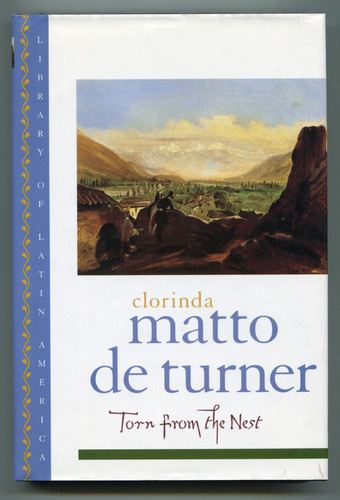
Torn from the Nest
0
0
As an Amazon Associate and affiliate partner, Menrva Books earns from qualifying purchases. Learn more
Author Description
Clorinda Matto de Turner was the first Peruvian novelist to command an international reputation and the first to dramatize the exploitation of indigenous Latin American people. She believed the task of the novel was to be the photograph that captures the vices and virtues of a people, censuring the former with the appropriate moral lesson and paying its homage of admiration to the latter. In this tragic tale, Clorinda Matto de Turner explores the relationship between the landed gentry and the indigenous peoples of the Andean mountain communities. While unfolding as a love story rife with secrets and dashed hopes, Torn from the Nest in fact reveals a deep and destructive class disparity, and criticizes the Catholic clergy for blatant corruption. When Lucia and Don Fernando Marin settle in the small hamlet of Killac, the young couple become advocates for the local Indians who are being exploited and oppressed by their priest and governor and by the gentry allied with these two. Considered meddling outsiders, the couple meet violent resistance from the village leaders, who orchestrate an assault on their house and pursue devious and unfair schemes to keep the Indians subjugated. As a romance blossoms between the a member of the gentry and the peasant girl that Lucia and Don Fernando have adopted, a dreadful secret prevents their marriage and brings to a climax the novel's exposure of degradation: they share the same father--a parish priest. Torn from the Nest was first published in Peru in 1889 amidst much enthusiasm and outrage. This fresh translation--the first since 1904--preserves one of Peru's most distinctive and compelling voices.
Menrva's Summary
THE PULSE
When a progressive couple attempts to defend an indigenous community from local corruption, they trigger a violent backlash that exposes the rot within the village hierarchy. Lucia and Don Fernando Marin arrive in the Andean hamlet of Killac with the intent of improving the lives of the local population, only to find themselves at odds with the entrenched power of the priest and the governor. The narrative follows their efforts to navigate a landscape of systemic exploitation, where their moral stance is met with physical threats and calculated sabotage. As the plot progresses, the focus shifts to a forbidden romance that uncovers a dark, shared lineage, serving as a final indictment of the moral decay within the ruling class.
INSIDE THE PAGES
- Social critique of the Catholic clergy and local government
- Exploration of class disparity in 19th-century Peru
- Romantic subplot serving as a vehicle for moral revelation
- Realistic depiction of Andean mountain community life
- Use of the novel as a didactic tool for social reform
- Conflict between progressive outsiders and traditional power structures
- Dramatic climax centered on the discovery of a secret parentage
- Historical context of post-colonial Latin American social dynamics
THE COLLECTIVE ECHO
Readers and critics frequently highlight the novel's significance as a foundational text in Latin American social realism. Discussion often centers on the author's bold decision to use fiction as a direct instrument for political and moral censure. The pacing is noted for its steady escalation, moving from a character-driven drama to a broader critique of institutional corruption. Many observers appreciate the balance between the intimate romantic narrative and the wider, systemic issues the author addresses. The work remains a subject of study for its early, unflinching portrayal of the exploitation of indigenous peoples by the landed gentry.
Page Count:
225
Publication Date:
1999-01-01
Publisher:
Oxford University Press
ISBN-10:
0199939012
ISBN-13:
9780199939015
Romance
English & College Success
Social Realism
Political
Latin American
English
Historical
Community Tags
Other Editions(4)
Similar Books






Reader Comments
Share Your Thoughts
No comments yet. Be the first to share your thoughts!