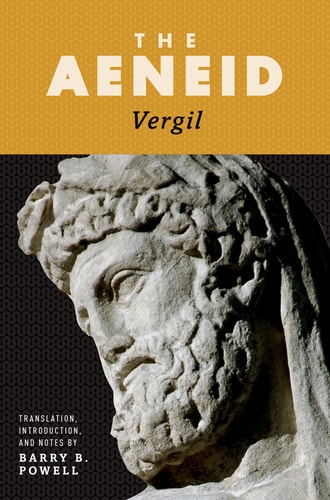
The Aeneid
0
0
As an Amazon Associate and affiliate partner, Menrva Books earns from qualifying purchases. Learn more
Author Description
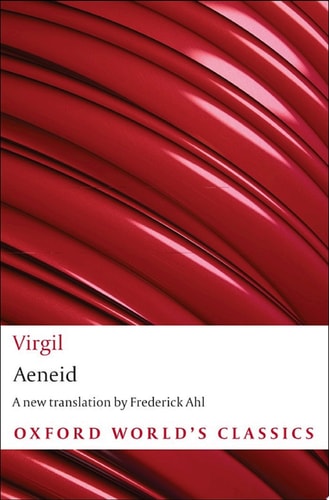
Barry Powell, acclaimed translator of the Iliad (OUP, 2013) and the Odyssey (OUP, 2014) now delivers a graceful, lucid, free-verse translation of the Aeneid in a pleasant modern idiom. On-page notes explain obscure literary and historical references, while the rich visual program lightens the text and educates students in the history of Western art by presenting a single topic as represented over 2,000 years.The Aeneid's first sentence charts the poem's historical plot, taking us in one sweep of seven lines from Homer's Troy to Augustus' Rome. These two layers of time are felt all the way through the poem, from the distant past of Aeneas' heroic and quasi-mythological time, over 1100 years before Vergil, down to the "now" of Augustus' Rome, when Vergil was writing the poem between 30 and 19 BC, a period of ongoing political experimentation.The story of Aeneas--moving from one continent to another, undergoing and enforcing great transformations in the process--transplants contemporary Augustan preoccupations with transition, continuity, and change into the remote time of the poem's action. In the course of the poem we move from the East to the West, from Troy to Italy, as Aeneas moves from being a Trojan towards being something else, a kind of Roman in embryo. The poem's migratory movement, together with its wholescale assimilation of Homer, acts out another great transition, the transition of Greek culture to Italy: just as the people of ancient Italy become the inheritors of Troy, so the people of Vergil's Italy become the inheritors of Greece. The very location of the poem in time is transitional, at the pivot between myth and history: the poem's characters are moving out of the era of Homer into the era of what Vergil would have considered non-fabulous history. In all these ways the Aeneid is a great poem of history, both as lived experience and as something constructed by people responding to the needs of society.Featuring a stellar, up-to-date introduction, on-
Menrva's Summary
THE PULSE
Aeneas, a Trojan survivor, must navigate the wrath of the gods and the weight of destiny to establish a new home in Italy, laying the foundations for what will become Rome. Driven by divine mandate and the necessity of survival, the protagonist faces physical trials, war, and the loss of his past as he transitions from a refugee of Troy to the progenitor of a new civilization. The narrative framework utilizes epic poetry, blending mythological encounters with the political realities of the Augustan era to explore themes of duty, loss, and national identity.
INSIDE THE PAGES
- Free-verse translation style designed for modern accessibility
- Extensive on-page annotations for historical and literary context
- Integration of a rich visual program featuring art history spanning 2,000 years
- Exploration of the transition from Greek cultural influence to Roman identity
- Dual-layered temporal structure connecting Homeric myth to Augustan history
- Focus on the geographical movement from East to West
- Analysis of the protagonist's evolution from Trojan warrior to Roman ancestor
- Inclusion of an up-to-date scholarly introduction
THE COLLECTIVE ECHO
Readers and critics frequently highlight the accessibility of this specific translation, noting that the free-verse style removes traditional barriers often found in older, more rigid renderings of the text. Discussion often centers on the effectiveness of the visual program, which provides a unique interdisciplinary approach by linking the poem to the broader history of Western art. Scholars appreciate the balance between the poem's mythological roots and the translator's clear, modern idiom that keeps the narrative pacing consistent. Many readers find the inclusion of on-page notes helpful for navigating the dense historical references without needing to flip to the back of the book. This edition is widely regarded as a practical entry point for those seeking to engage with the epic's complex themes of transition and historical legacy.
Page Count:
432
Publication Date:
2015-08-03
Publisher:
Oxford University Press
ISBN-10:
0190204958
ISBN-13:
9780190204952
Mythology
Epic Poetry
Classic Literature
Ancient History
Translation
Community Tags
Similar Books