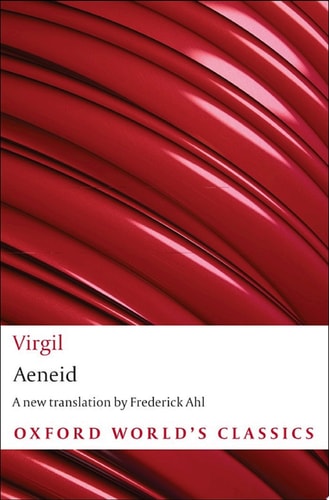
Aeneid
0
0
As an Amazon Associate and affiliate partner, Menrva Books earns from qualifying purchases. Learn more
Author Description
'Arms and the man I sing of Troy...' So begins one of the greatest works of literature in any language. Written by the Roman poet Virgil more than two thousand years ago, the story of Aeneas' seven-year journey from the ruins of Troy to Italy, where he becomes the founding ancestor of Rome, is a narrative on an epic scale: Aeneas and his companions contend not only with human enemies but with the whim of the gods. His destiny preordained by Jupiter, Aeneas is nevertheless assailed by dangers invoked by the goddess Juno, and by the torments of love, loyalty, and despair. Virgil's supreme achievement is not only to reveal Rome's imperial future for his patron Augustus, but to invest it with both passion and suffering for all those caught up in the fates of others. Frederick Ahl's new translation echoes the Virgilian hexameter in a thrillingly accurate and engaging style. An Introduction by Elaine Fantham, and Ahl's comprehensive notes and invaluable indexed glossary complement the translation. ABOUT THE SERIES: For over 100 years Oxford World's Classics has made available the widest range of literature from around the globe. Each affordable volume reflects Oxford's commitment to scholarship, providing the most accurate text plus a wealth of other valuable features, including expert introductions by leading authorities, helpful notes to clarify the text, up-to-date bibliographies for further study, and much more.
Menrva's Summary
THE PULSE
Aeneas, a survivor of the fallen city of Troy, must navigate the wrath of the gods to establish a new home in Italy and fulfill his destiny as the progenitor of the Roman people. Driven by divine mandate, Aeneas leads his displaced companions across the Mediterranean, facing environmental hazards and the persistent interference of the goddess Juno. The narrative follows his struggle to balance personal desire and emotional attachments against the rigid requirements of his duty to his people and the gods. The poem utilizes a formal, elevated structure to document the transition from the chaos of war to the foundation of a new civilization. The text is presented as an epic poem, employing rhythmic structures that mirror the original Latin hexameter.
INSIDE THE PAGES
- Use of dactylic hexameter verse structure
- Incorporation of Olympian deities as active narrative agents
- Themes of duty, piety, and the cost of empire
- Extensive use of epic similes and classical imagery
- Non-linear narrative elements through flashbacks to the fall of Troy
- Focus on the psychological toll of leadership and exile
- Exploration of the tension between individual agency and fate
- Detailed descriptions of armor, battle, and ritual sacrifice
THE COLLECTIVE ECHO
Discussion often centers on the complex portrayal of Aeneas, who is frequently analyzed as a figure defined more by his obligations than his personal inclinations. Readers frequently highlight the contrast between the poem's public celebration of Roman imperial identity and the private moments of suffering experienced by the characters. Critics often examine the effectiveness of the translation in capturing the sonic qualities of the original Latin while maintaining accessibility for modern readers. The work is widely recognized for its influence on Western literature and its sophisticated use of mythological framework to comment on contemporary political power. Scholars continue to debate the extent to which Virgil intended the poem to be a straightforward endorsement of the Augustan regime or a more nuanced critique of the human price of historical progress.
Page Count:
530
Publication Date:
2008-01-01
Publisher:
OUP Oxford
ISBN-10:
019162277X
ISBN-13:
9780191622779
Poetry
Epic Poetry
Mythology
English & College Success
English
Classic Literature
Roman History
Community Tags
Similar Books