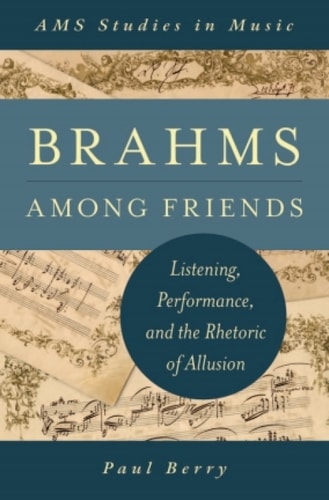
Brahms Among Friends: Listening, Performance, and the Rhetoric of Allusion
0
0
As an Amazon Associate and affiliate partner, Menrva Books earns from qualifying purchases. Learn more
Author Description
Brahms Among Friends identifies patterns of listening, performance, and composition among close friends of Johannes Brahms and explores how those patterns informed the creation and reception of his music in the intimate genres of song, sonata, trio, and piano miniature. Among the tangled threads of counterpoint and circumstance that bound Brahms to his acquaintances was the technique of allusive musical borrowing, whereby a brief passage from a familiar work was drawn into the fabric of a new composition. For the specific listeners whose habits of mind and musicianship he knew best, allusive borrowings could become rhetorically charged gestures, persuasively revising the meanings his music conveyed and the interpretive strategies it invited.Primary documents, original manuscripts, music-analytic comparison, and kinesthetic parameters experienced in the act of performance all work in tandem to support ten case studies in the interplay between Brahms's small-scale works and the women and men who encountered them before publication. Central characters include violinist Joseph Joachim, singers Amalie Joachim, Julius Stockhausen, and Agathe von Siebold, composers Heinrich and Elisabeth von Herzogenberg, and pianists Emma Engelmann and Clara Schumann. For these musicians and for the composer himself, Brahms's allusive music served a broad variety of emotional needs and interpersonal ends. Yet across diverse repertoire and interdisciplinary correlates ranging from ethnography to psychoanalysis, each case study furthers a single, underlying aim: to reconstruct the mutually dependent perspectives of historically situated agents and restore forgotten features of their communicative landscapes as bases for both musical and historical scrutiny.
Menrva's Summary
THE THESIS
How did the intimate social and musical circles of Johannes Brahms influence the composition and reception of his smaller-scale works? Paul Berry, a scholar of musicology, investigates the intersection of performance, listening habits, and the technique of allusive musical borrowing within Brahms's personal network. By analyzing primary documents, manuscripts, and the specific musicianship of the composer's acquaintances, the author argues that these allusions functioned as rhetorically charged gestures designed for a specific, informed audience. The work reconstructs the communicative landscapes of the 19th-century musical elite to provide a deeper understanding of how interpersonal relationships shaped the meaning of Brahms's music.
THE SCOPE MAP
What You Will Find
- Ten detailed case studies focusing on song, sonata, trio, and piano miniature genres.
- Analysis of the technique of allusive musical borrowing as a communicative tool.
- Examination of primary source documents, including original manuscripts and historical correspondence.
- Interdisciplinary perspectives incorporating ethnography and psychoanalysis to interpret musical reception.
THE AUTHORITY PERSPECTIVE
Experts recognize this work as a significant contribution to the study of Brahms, particularly for its focus on the social context of his private compositions. Readers frequently note the academic density of the prose, which provides a rigorous framework for understanding the interplay between historical agents and musical output.
Page Count:
400
Publication Date:
2014-01-01
Publisher:
Oxford University Press
ISBN-10:
0199982651
ISBN-13:
9780199982653
History
Music
Biography
Conducting
Music History
Musicology
Humanities
Community Tags
Similar Books