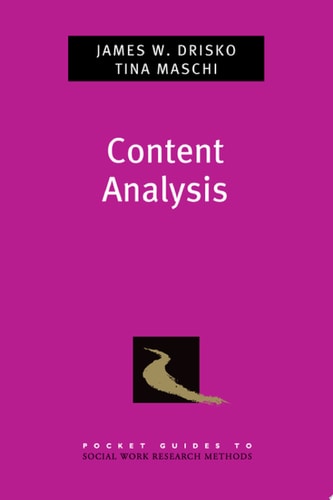
Content Analysis: Pocket Guide to Social Work Research Methods
0
0
As an Amazon Associate and affiliate partner, Menrva Books earns from qualifying purchases. Learn more
Author Description
Content Analysis offers a comprehensive overview of the variation within content analysis, along with detailed descriptions of three approaches found in the contemporary literature: basic content analysis, interpretive content analysis and qualitative content analysis. This book provides an inclusive, and carefully differentiated, examination of contemporary content analysis research purposes and methods. Such a book is not currently available. Chapter One examines the conceptual base and history of content analysis, then the next three chapters examine each approach to content analysis in depth, using brief illustrative exemplar studies. Each of the methodology chapters employs a consistent outline to help readers compare and contrast the three different approaches. Chapter 5 examines rigor in content analysis and highlights steps to ensure the internal coherence of studies. This book concludes with exploration of two full-length studies: Chapter 6 examines the use of content analysis for advocacy and building public awareness to promote human rights and social justice. Chapter 7 reviews a full-length study of older adults in prison to detail how content analysis is completed and how different approaches may be usefully combined.
Menrva's Summary
THE THESIS
This book investigates the methodological variations within content analysis to provide a structured framework for researchers in the field of social work. Authors James Drisko and Tina Maschi utilize their academic expertise to differentiate between basic, interpretive, and qualitative content analysis, offering a systematic approach to research design. The text serves as a pedagogical tool, grounding theoretical concepts in practical application to assist students and practitioners in executing rigorous studies.
THE SCOPE MAP
What You Will Find
- A comparative analysis of basic, interpretive, and qualitative content analysis methods.
- A consistent chapter outline designed to facilitate the comparison of different research approaches.
- Detailed examinations of rigor and internal coherence in qualitative studies.
- Full-length case studies focusing on human rights advocacy and the experiences of older adults in prison.
Scope Limits
- The text focuses specifically on social work research applications rather than broad, interdisciplinary data science or computational linguistics.
- It does not provide an exhaustive history of quantitative content analysis techniques.
THE AUTHORITY PERSPECTIVE
Experts and students frequently cite this text as a foundational resource for understanding the nuances of qualitative research within social work. Readers often note the clarity of the comparative framework, which helps simplify complex methodological distinctions for those new to the field.
Page Count:
208
Publication Date:
2015-01-01
Publisher:
Oxford University Press
ISBN-10:
019021550X
ISBN-13:
9780190215507
Qualitative Research
Content Analysis Communication
Research Methods
Social Science
Social Work
Introduction to Social WorkWelfare
Community Tags
Similar Books