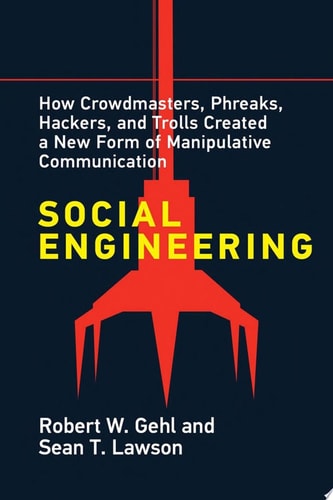
Social Engineering
0
0
As an Amazon Associate and affiliate partner, Menrva Books earns from qualifying purchases. Learn more
Author Description
Manipulative communication—from early twentieth-century propaganda to today’s online con artistry—examined through the lens of social engineering. The United States is awash in manipulated information about everything from election results to the effectiveness of medical treatments. Corporate social media is an especially good channel for manipulative communication, with Facebook a particularly willing vehicle for it. In Social Engineering, Robert Gehl and Sean Lawson show that online misinformation has its roots in earlier techniques: mass social engineering of the early twentieth century and interpersonal hacker social engineering of the 1970s, converging today into what they call “masspersonal social engineering.” As Gehl and Lawson trace contemporary manipulative communication back to earlier forms of social engineering, possibilities for amelioration become clearer. The authors show how specific manipulative communication practices are a mixture of information gathering, deception, and truth-indifferent statements, all with the instrumental goal of getting people to take actions the social engineer wants them to. Yet the term “fake news,” they claim, reduces everything to a true/false binary that fails to encompass the complexity of manipulative communication or to map onto many of its practices. They pay special attention to concepts and terms used by hacker social engineers, including the hacker concept of “bullshitting,” which the authors describe as a truth-indifferent mix of deception, accuracy, and sociability. They conclude with recommendations for how society can undermine masspersonal social engineering and move toward healthier democratic deliberation.
Menrva's Summary
THE THESIS
This book investigates the historical evolution and contemporary manifestations of manipulative communication, particularly through the lens of social engineering. The authors, Robert Gehl and Sean Lawson, trace the roots of online misinformation from early twentieth-century propaganda and 1970s hacker techniques to the current era of "masspersonal social engineering." They argue that manipulative communication is a complex blend of information gathering, deception, and truth-indifferent statements designed to elicit specific actions from individuals. The book critically examines the limitations of terms like "fake news" in capturing this complexity and explores concepts such as the hacker notion of "bullshitting."
THE SCOPE MAP
- Analysis of manipulative communication techniques from the early 20th century to the present.
- Examination of online misinformation and its roots in social engineering.
- Discussion of "masspersonal social engineering" as a convergence of historical methods.
- Exploration of concepts like "bullshitting" as used by hacker social engineers.
- Case studies of manipulative communication on corporate social media platforms, with a focus on Facebook.
- Recommendations for mitigating masspersonal social engineering and fostering democratic deliberation.
THE AUTHORITY PERSPECTIVE
The book examines the historical development and current landscape of manipulative communication, arguing that contemporary online misinformation stems from earlier forms of social engineering. It critiques the simplistic "fake news" binary and introduces the concept of "masspersonal social engineering." The authors propose strategies to counter these manipulative practices and promote healthier public discourse.
Page Count:
344
Publication Date:
2022-03-08
Publisher:
Random House Publishing Services
ISBN-10:
0262368935
ISBN-13:
9780262368933
Politics
Non-Fiction
History
Media Studies
Technology
Communication
Sociology
Community Tags
Similar Books