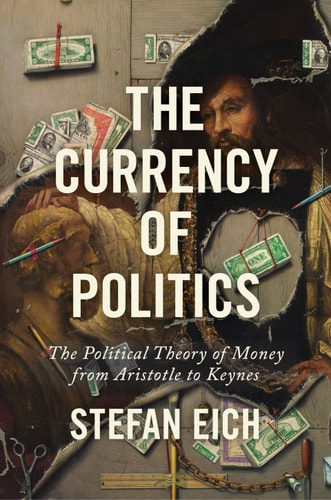
The Currency of Politics
0
0
As an Amazon Associate and affiliate partner, Menrva Books earns from qualifying purchases. Learn more
Author Description
Money in the history of political thought, from ancient Greece to the Great Inflation of the 1970s In the wake of the 2008 financial crisis, critical attention has shifted from the economy to the most fundamental feature of all market economies—money. Yet despite the centrality of political struggles over money, it remains difficult to articulate its democratic possibilities and limits. The Currency of Politics takes readers from ancient Greece to today to provide an intellectual history of money, drawing on the insights of key political philosophers to show how money is not just a medium of exchange but also a central institution of political rule. Money appears to be beyond the reach of democratic politics, but this appearance—like so much about money—is deceptive. Even when the politics of money is impossible to ignore, its proper democratic role can be difficult to discern. Stefan Eich examines six crucial episodes of monetary crisis, recovering the neglected political theories of money in the thought of such figures as Aristotle, John Locke, Johann Gottlieb Fichte, Karl Marx, and John Maynard Keynes. He shows how these layers of crisis have come to define the way we look at money, and argues that informed public debate about money requires a better appreciation of the diverse political struggles over its meaning. Recovering foundational ideas at the intersection of monetary rule and democratic politics, The Currency of Politics explains why only through greater awareness of the historical limits of monetary politics can we begin to articulate more democratic conceptions of money.
Menrva's Summary
THE THESIS
This book investigates the historical and philosophical underpinnings of money as a fundamental institution of political rule. Stefan Eich, drawing on the insights of key political philosophers from ancient Greece to the 1970s, examines six crucial episodes of monetary crisis to demonstrate how money is not merely a medium of exchange but a central element of political power. The work recovers neglected political theories of money from figures such as Aristotle, John Locke, Johann Gottlieb Fichte, Karl Marx, and John Maynard Keynes. Eich argues that understanding these historical struggles over money's meaning is essential for articulating more democratic conceptions of its role.
THE SCOPE MAP
- An intellectual history of money from ancient Greece to the 1970s.
- Analysis of money's role as a central institution of political rule, not just a medium of exchange.
- Examination of six crucial episodes of monetary crisis throughout history.
- Recovery of neglected political theories of money from key philosophers including Aristotle, Locke, Fichte, Marx, and Keynes.
- Argument for the necessity of understanding historical monetary struggles to develop democratic conceptions of money.
THE AUTHORITY PERSPECTIVE
The book is positioned as a critical examination of money's role in political thought, particularly in the wake of the 2008 financial crisis. It aims to provide readers with a deeper understanding of the democratic possibilities and limitations surrounding monetary systems by tracing their intellectual history. The work recovers foundational ideas at the intersection of monetary rule and democratic politics, suggesting that an awareness of historical limits is key to articulating more democratic future conceptions of money.
Page Count:
304
Publication Date:
2022-05-24
Publisher:
Princeton University Press
ISBN-10:
0691235449
ISBN-13:
9780691235448
Philosophy
Non-Fiction
History
Economic History
Political Theory
Community Tags
Similar Books