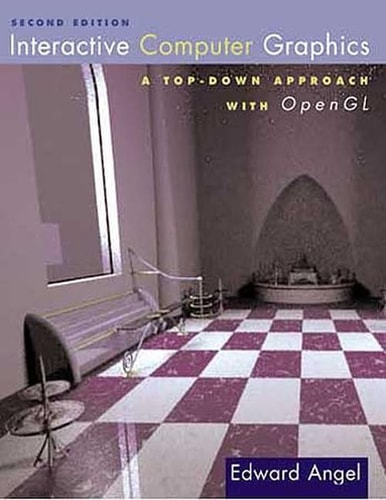
Interactive Computer Graphics: A Top-Down Approach with OpenGL
0
0
As an Amazon Associate and affiliate partner, Menrva Books earns from qualifying purchases. Learn more
Author Description
This introductory text recognizes that beginners learn computer graphics more quickly by doing it. Taking a top-down approach, the book gets you started early in writing interesting 3D graphics programs. Each chapter is built around a nontrivial application program. In this programming context, key principles and techniques are explained as needed and in increasing detail. Coverage includes all the topics required for a fundamental understanding of computer graphics, such as light-material interactions, shading, modeling, curves and surfaces, anti-aliasing, texture mapping, and compositing, as well as important hardware issues.To enable this top-down approach, the book first describes an important application programmer's interface, OpenGL, a graphics library available on most platforms, from high-end graphics workstations to PCs. This high-level interface and a basic knowledge of C programming allow you to generate complex interactive applications, even applications involving 3D viewing and event-driven input. OpenGL's well-defined architecture also facilitates the book's technical discussions of algorithm implementations.The Second Edition of this widely used book features enhanced discussion of hierarchy and object orientation, visualization, interaction, and projection; includes additional code examples, such as two new variants of the Sierpinski gasket, display of hierarchical models, shadow generation, and visualization; and covers functionality added to OpenGL 1.1, including vertex arrays.
Menrva's Summary
THE THESIS
This text investigates how a top-down pedagogical approach, centered on practical application, accelerates the acquisition of computer graphics principles for beginners. Edward Angel, a professor of computer science, utilizes his extensive academic background to structure the learning process around the OpenGL application programmer's interface. By prioritizing immediate implementation over abstract theory, the book provides a framework where technical concepts are introduced as they become necessary for building functional 3D graphics programs.
THE SCOPE MAP
What You Will Find
- Comprehensive coverage of OpenGL 1.1 functionality including vertex arrays and high-level interfaces.
- Practical implementation techniques for light-material interactions, shading, and texture mapping.
- Detailed instruction on modeling, curves, surfaces, anti-aliasing, and compositing.
- Case studies and code examples involving hierarchical models, shadow generation, and visualization.
THE AUTHORITY PERSPECTIVE
Experts and educators frequently cite this work as a foundational text for students transitioning into 3D graphics programming. Readers often note the technical density of the prose, which requires a solid grasp of C programming to fully utilize the provided examples.
Page Count:
612
Publication Date:
1999-08-06
Publisher:
Addison-Wesley
ISBN-10:
020138597X
ISBN-13:
9780201385977
Programming
Computer Science
textbook
Computer Systems
graphics
Community Tags
Other Editions(4)

Similar Books







Reader Comments
Share Your Thoughts
No comments yet. Be the first to share your thoughts!