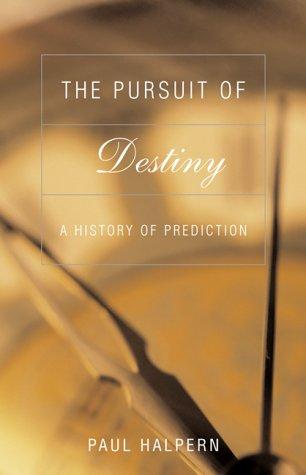
The Pursuit of Destiny
0
0
As an Amazon Associate and affiliate partner, Menrva Books earns from qualifying purchases. Learn more
Author Description
A professor of physics and prolific author, Halpern shows how prediction - as we think of it now - emerged during the birth of modern science in the seventeenth and eighteenth centuries. As scientists discovered the workings of the cosmos, their models allowed for predictions of amazing sophistication and accuracy. Belief in the power of Newtonian mechanics to explain and predict all aspects of the physical world led to scientists' conviction that fate was the inevitable outcome of natural laws and principles. Breakthroughs in the early part of the twentieth century, however - from Heisenberg's uncertainty principle to Einstein's concepts of relative time and space - revealed the limits of our ability to comprehend the universe, forcing scientists to employ other methods of forecasting. Drawing on modern theories of complexity, chaos theory, quantum theory, and relativity, Halpern explores the latest methods of scientific, social, and technological prediction. Will we ever be able to understand and predict the stock market, social interaction, or the weather? When are predictions most likely to succeed? Does time even exist?--BOOK JACKET.
Menrva's Summary
THE THESIS
The Pursuit of Destiny explores the historical evolution of scientific prediction, from the deterministic models of the seventeenth and eighteenth centuries to the probabilistic and complex systems of the twentieth and twenty-first centuries.
THE SCOPE MAP
- The emergence of prediction as a scientific concept during the birth of modern science.
- The impact of Newtonian mechanics on the belief in deterministic fate.
- How early twentieth-century breakthroughs (Heisenberg's uncertainty principle, Einstein's relativity) revealed the limits of prediction.
- Exploration of modern theories of complexity, chaos theory, quantum theory, and relativity in forecasting.
- Analysis of the predictability of complex systems like the stock market, social interaction, and weather.
- Discussion on the conditions under which predictions are most likely to succeed.
- Philosophical considerations on the nature of time and its relation to prediction.
THE AUTHORITY PERSPECTIVE
Paul Halpern, a physics professor and author, is recognized for his ability to explain complex scientific concepts. The book traces the historical development of scientific prediction, highlighting the shift from deterministic to probabilistic models. It examines how scientific understanding has evolved regarding our capacity to forecast events in both the natural and social worlds. The work is likely to appeal to readers interested in the history of science, philosophy of science, and the fundamental questions surrounding predictability and time.
Page Count:
250
Publication Date:
2000-01-01
ISBN-10:
0738200956
ISBN-13:
9780738200958
Non-Fiction
History
Science
Philosophy
Physics
Community Tags
Similar Books