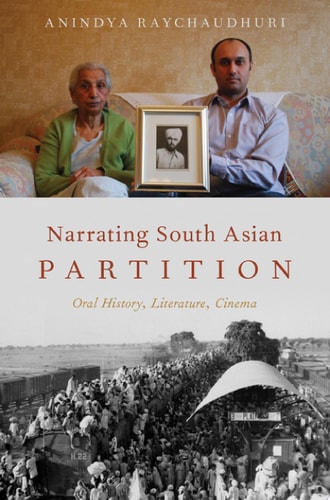
Narrating South Asian Partition: Oral History, Literature, Cinema
0
0
As an Amazon Associate and affiliate partner, Menrva Books earns from qualifying purchases. Learn more
Author Description
The history of the 1947 Indian/Pakistani partition is one of separation: a country and people newly divided. However, in telling this story, Anindya Raychaudhuri, the son of a partition participant, looks to unity, joining for the first time the public and private memory narratives of this pivotal moment in time. Narrating Partition features in-depth interviews with more than 120 individuals across India, Pakistan, Bangladesh, and the United Kingdom, each reflecting on a direct or inherited experience of the 1947 Indian/Pakistani partition. Through the collection of these oral history narratives, Raychaudhuri is able to place them into comparison with the literary, cinematic, and artistic representations of partition, and in doing so, examine the ways this event is remembered, re-interpreted, and reconstructed--and the narrator's role in this process. These stories also reflect on the themes of home, family, violence, childhood, trains, and rivers within these public and private narratives. Crucially, Raychaudhuri is the first writer to use oral history in addressing the Bengal/Punjab partition as part of this same event, examining the memorial legacy in both the Bengali and Punjabi communities.
Menrva's Summary
THE THESIS
This work investigates how the 1947 partition of India and Pakistan is remembered and reconstructed through the intersection of personal oral histories and public cultural representations. Anindya Raychaudhuri, drawing on his background as a scholar and the child of a partition survivor, synthesizes over 120 interviews with literary, cinematic, and artistic analyses. He argues that by bridging the gap between private memory and public narrative, one can better understand the enduring impact of the partition on the collective consciousness of India, Pakistan, Bangladesh, and the United Kingdom.
THE SCOPE MAP
What You Will Find
- Comparative analysis of oral histories alongside literature, film, and art.
- Examination of the Bengal and Punjab partitions as a unified historical event.
- Thematic exploration of home, family, violence, childhood, and migration.
Scope Limits
- The study focuses primarily on the memorial and narrative legacy rather than a comprehensive political or military history of the partition.
THE AUTHORITY PERSPECTIVE
Scholars and historians recognize this text as a significant contribution to the field of oral history for its unique synthesis of cross-regional narratives. Readers frequently note the academic rigor and the sensitive, nuanced approach the author takes when handling traumatic personal accounts.
Page Count:
233
Publication Date:
2019-01-01
Publisher:
Oxford University Press
ISBN-10:
0190249765
ISBN-13:
9780190249762
History
Middle Eastern
Asian Studies
Bengal India
Special Topics
Sociology
Asian History
Oral History
Community Tags
Similar Books