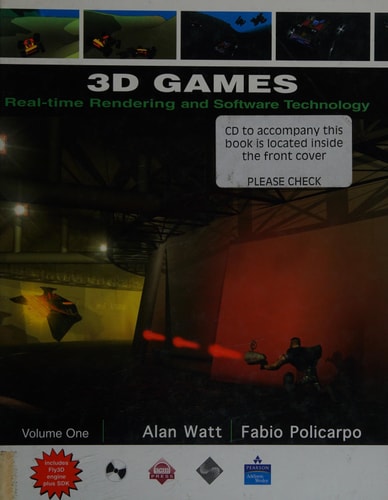
3D Games: Real-Time Rendering and Software Technology, Volume 1
0
0
As an Amazon Associate and affiliate partner, Menrva Books earns from qualifying purchases. Learn more
Author Description
This is the first academic games programming book/CD package that is expressly written for new degree courses in 3D-games programming. Authors introduce the theory behind the design of computer games and detail advanced techniques used in the industry.Students will be able to develop their own games within the game 'skeletons' accompanying the book, and will learn how to program complex games. This book could also be used for a more standard undergraduate 3D graphics programming course, with the games context being highly motivational.This book is a comprehensive treatment of current 3D games technology, including:* Theoretical foundations* Classical 3D graphics* Real-time rendering technology* Dynamics* Collision detection* Artificial Intelligence* Image-based rendering* Multi-player technology* Software technology* Engine architectureThe text is written around an actual engine that implements most of the described techniques and accompanies the book on a CD-ROM. Readers can try out their own ideas by writing source code and can experiment with existing demonstrations by writing or altering plug-ins.The supplied engine features are:* BSP/PVS render management* Light maps for static geometry* Diffuse and specular (hardware) vertex lighting for dynamic objects* Volumetric fog with fog maps* Detail textures* Multi-texture support* Collision detection* Dynamic lights* Dynamic Shadows* Physically based animations* Animated meshed* Tri-strips and fans* Subdivision surfaces* 3D sound support* Complete plug-in directed
Menrva's Summary
THE THESIS
This text investigates the core theoretical and practical frameworks required to engineer high-performance 3D game engines. Authors Alan Watt and Fabio Policarpo leverage their expertise in computer graphics to bridge the gap between academic theory and industry-standard software implementation. By providing a functional engine alongside the text, the authors establish a pedagogical environment where students can apply complex rendering and architectural concepts directly to functional code.
THE SCOPE MAP
What You Will Find
- Comprehensive coverage of real-time rendering pipelines and engine architecture.
- Practical implementation of collision detection, dynamics, and artificial intelligence.
- Technical documentation for BSP/PVS render management and multi-texture support.
- Hands-on application through a provided game engine and plug-in development environment.
THE AUTHORITY PERSPECTIVE
Experts recognize this work as a foundational resource for undergraduate-level game programming curricula. Readers frequently note the technical density of the prose, which effectively balances high-level theory with the practical constraints of real-time software development.
Page Count:
800
Publication Date:
2000-12-15
Publisher:
Addison-Wesley
ISBN-10:
0201619210
ISBN-13:
9780201619218
Computer graphics
computer games
Programming
Computer Science
Software Engineering
Community Tags
Similar Books