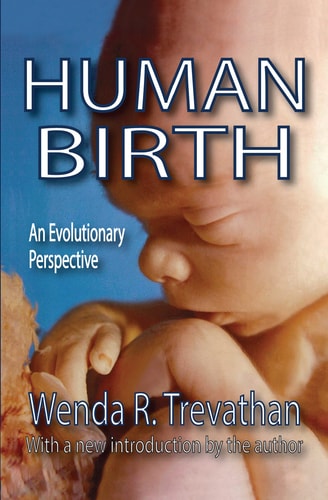
Human Birth: An Evolutionary Perspective
0
0
As an Amazon Associate and affiliate partner, Menrva Books earns from qualifying purchases. Learn more
Author Description
The story of human evolution has been told hundreds of times, each time with a focus that seems most informative of the teller. No matter how it is told the primary characters are rarely mothers and infants. Darwin argued survival, but today we know that reproduction is what evolution is all about. Centering on this, Trevathan focuses on birth, which gives the study of human evolution a crucial new dimension.Unique among mammals, humans are bipedal. The evolution of bipedalism required fundamental changes in the pelvis and resulted in a narrow birth canal. Humans are also large-brained animals, which means that birth is much more challenging for our species than for most other animals. The result of this mismatch of large head and narrow pelvis is that women are highly dependent on assistance at birth and their babies are born in an unusually undeveloped state when the brain is still small. Human Birth discusses how the birth process has evolved and ways in which human birth differs from birth in all other mammals.Human Birth is also concerned with mother-infant interaction immediately after birth. While working as a midwife trainee, Trevathan carefully documented the births of more than one hundred women and recorded maternal and infant behaviors during the first hour after birth. She suggests ways in which the interactions served not only to enhance mother-infant bonding, but also to ensure survival in the evolutionary past. With clarity and compelling logic Trevathan argues that modern birth practices often fail to meet evolved needs of women and infants and suggests changes that could lead to better birth experiences. This paperback edition includes a new introduction by the author.
Menrva's Summary
THE THESIS
This work investigates how the unique evolutionary pressures of bipedalism and large brain size have shaped the human birth process and subsequent maternal-infant interactions. Dr. Wenda Trevathan, a biological anthropologist and midwife trainee, utilizes a synthesis of fossil record data, comparative primatology, and direct clinical observation to construct her argument. She posits that the physiological constraints of the human pelvis, combined with the requirements of a large-brained neonate, necessitate social support during labor, a departure from the solitary birth patterns observed in most other mammals.
THE SCOPE MAP
What You Will Find
- Comparative analysis of birth mechanics across mammalian species.
- Examination of the anatomical trade-offs between bipedalism and the birth canal.
- Observational data from over one hundred documented human births.
- Discussion of the evolutionary significance of immediate postpartum maternal-infant bonding behaviors.
THE AUTHORITY PERSPECTIVE
Experts recognize this text as a foundational contribution to the field of evolutionary medicine and reproductive anthropology. Readers frequently note the balance between rigorous scientific data and the author's practical experience as a midwife, making the complex biological arguments accessible to a broad audience.
Page Count:
286
Publication Date:
1987-12-31
Publisher:
Routledge
ISBN-10:
0202020290
ISBN-13:
9780202020297
Science
Anthropology
Evolutionary Biology
Sociology
Medicine
Childbirth