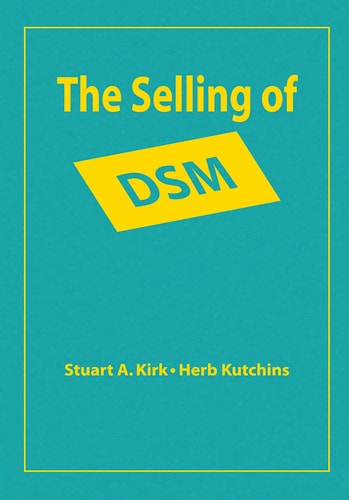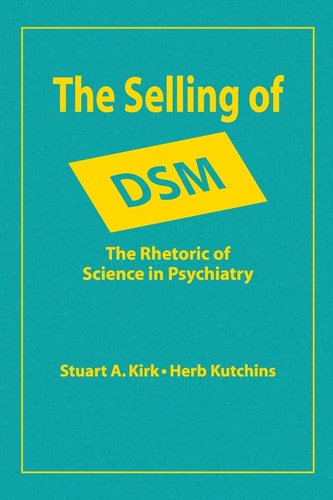
The Selling of DSM: The Rhetoric of Science in Psychiatry
0
0
As an Amazon Associate and affiliate partner, Menrva Books earns from qualifying purchases. Learn more
Author Description
When it was first published in 1980, the Diagnostic and Statistical Manual of Mental Disorders, Third Edition―universally known as DSM-III―embodied a radical new method for identifying psychiatric illness. Kirk and Kutchins challenge the general understanding about the research data and the process that led to the peer acceptance of DSM-III. Their original and controversial reconstruction of that moment concentrates on how a small group of researchers interpreted their findings about a specific problem―psychiatric reliability―to promote their beliefs about mental illness and to challenge the then-dominant Freudian paradigm.
Menrva's Summary
THE THESIS
This book investigates the rhetorical strategies and sociopolitical processes that facilitated the adoption of the DSM-III as the standard diagnostic tool in psychiatry. Stuart A. Kirk and Herb Kutchins examine the historical transition from Freudian psychoanalytic paradigms to the structured, reliability-focused criteria of the DSM-III. By analyzing the internal research data and the influence of a small group of key researchers, the authors argue that the manual's success was driven more by strategic consensus-building than by objective scientific discovery. The text provides a critical reconstruction of how psychiatric reliability was framed to reshape the field's professional identity.
THE SCOPE MAP
What You Will Find
- Historical analysis of the development and implementation of the DSM-III in 1980.
- Examination of the shift from psychoanalytic models to diagnostic criteria.
- Evaluation of the role of psychiatric reliability as a rhetorical tool.
- Case studies on the consensus-building processes among psychiatric researchers.
THE AUTHORITY PERSPECTIVE
Experts and historians of medicine frequently cite this work as a foundational critique of psychiatric classification systems. Readers often note the academic density of the prose, which provides a rigorous examination of the intersection between institutional power and scientific rhetoric.
Page Count:
280
Publication Date:
1992-06-30
Publisher:
Routledge
ISBN-10:
0202304329
ISBN-13:
9780202304328
Psychology
Sociology
Medical Ethics
Psychiatry
Mental Illness