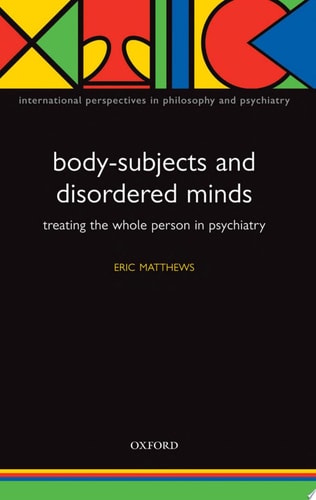
Body-Subjects and Disordered Minds: Treating the 'Whole' Person in Psychiatry
0
0
As an Amazon Associate and affiliate partner, Menrva Books earns from qualifying purchases. Learn more
Author Description
How should we deal with mental disorder - as an "illness" like diabetes or bronchitis, as a "problem in living", or what? This book seeks to answer such questions by going to their roots, in philosophical questions about the nature of the human mind, the ways in which it can be understood, and about the nature and aims of scientific medicine.The controversy over the nature of mental disorder and the appropriateness of the "medical model" is not just an abstract theoretical debate: it has a bearing on very practical issues of appropriate treatment, as well as on psychiatric ethics and law. A major contention of this book is that these questions are ultimately philosophical in character: they can be resolved only if we abandon some widespread philosophical assumptions about the "mind" and the "body", and about what it means for medicine to be "scientific".The "phenomenological" approach of the twentieth-century French philosopher, Maurice Merleau-Ponty is used to question these assumptions. His conception of human beings as "body-subjects" is argued to provide a more illuminating way of thinking about mental disorder and the ways in which it can be understood and treated. The conditions we conventionally call "mental disorders" are, it is argued, not a homogeneous group: the standard interpretation of the medical model fits some more readily than others. The core mental disorders, however, are best regarded as disturbed ways of being in the world, which cause unhappiness because of deviation from "human" rather than straightforwardly "biological" norms. That is, they are problems in how we experience the world and especially other people, rather than in physiological functioning - even though the nature of our experience cannot ultimately be separated from the ways in which our bodies function. This analysis is applied within the book both to issues in clinical treatment and to the special ethical and legal questions of psychiatry.Written by a well known philosopher i
Menrva's Summary
THE THESIS
This book investigates the fundamental philosophical question of whether mental disorders should be classified strictly as biological illnesses or as complex problems in human living. Eric Matthews, a philosopher, challenges the prevailing medical model by examining the nature of the human mind and the limitations of scientific medicine. He argues that current psychiatric practices rely on flawed assumptions about the mind-body dualism, proposing instead that mental disorders are better understood as disturbed ways of being in the world.
THE SCOPE MAP
What You Will Find
- An application of Maurice Merleau-Ponty's phenomenological philosophy to modern psychiatric theory.
- A critical analysis of the medical model and its limitations in treating mental health conditions.
- An exploration of the concept of the human being as a 'body-subject' to bridge the gap between biological and experiential understanding.
- Ethical and legal implications of psychiatric treatment paradigms.
THE AUTHORITY PERSPECTIVE
Experts and readers often note the academic density of the prose, which requires a strong background in philosophical inquiry to fully grasp. The text is widely regarded as a foundational contribution to the philosophy of psychiatry, providing a necessary critique of purely reductionist medical approaches.
Page Count:
200
Publication Date:
2007-02-15
Publisher:
Oxford University Press
ISBN-10:
0198566433
ISBN-13:
9780198566434
Philosophy
Mind & Body
Medical Ethics
Mental Health
Psychiatry
Medical
Phenomenology
Allied Health
Mental Illness
Community Tags
Other Editions(2)

Similar Books



Reader Comments
Share Your Thoughts
No comments yet. Be the first to share your thoughts!