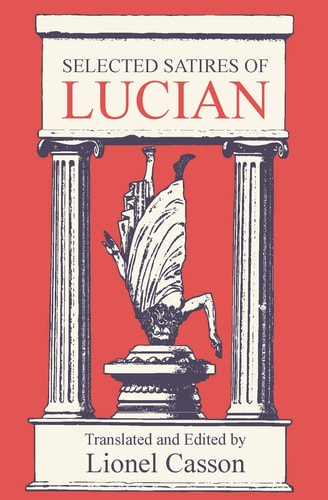
Selected Satires of Lucian
0
0
As an Amazon Associate and affiliate partner, Menrva Books earns from qualifying purchases. Learn more
Author Description
The unsurpassed satirist of the ancient era was a young Syrian named Lucian, who, writing in Greek in the second century a.d., combined wit, irony, fearless candor, and exuberant comic fantasy to create the triumphantly irreverent dialogues and stories contained in this book. His genial mockery, aimed at man's omnipresent feelings, has never gone out of date. The jabs he gave the hypocrites; grandstanders, fakers and boobs of the ancient world can just as appropriately be administered to their counterparts in the modern world.Lucian's most typical genre is a parody of a Platonic dialogue, in which Zeus, Hermes, Eros, and other Olympians jabber in undivine harassment as some clever mortal (who very much resembles Lucian) is about to make scandalous fools of them. He also excelled at straight narrative, his two most famous tales being the elaborate science fiction spoof; "A True Story," and an old folk tale retold outrageously, "Lucius the Ass." His works were the product of an unrelentingly rational and skeptical mind, and have had an incalculable effect on writers and painters through the ages.Until this volume, the English language reader of today to appreciate the importance and intelligence of Lucian. No volume of representative selections in translation is in print. There are satisfactory versions of the complete works, but the reader who takes this long will most likely lose a good deal of the sting of Lucian's needle. Lionel Cassen also illustrates the full range of Lucian's subject matter and various literary forms and when translating tried to focus on the Greek spirit as opposed to the literal meaning.
Menrva's Summary
THE PULSE
Lucian of Samosata utilizes biting wit and irreverent dialogue to dismantle the pretensions of ancient gods, philosophers, and social climbers. Through a series of parodic dialogues and fantastical narratives, the author challenges the rigid intellectual and religious structures of the second-century Mediterranean world. The text employs a skeptical, rationalist framework to expose human folly, often positioning a clever, clear-eyed mortal protagonist against the absurdities of the divine and the pompous. These stories function as a mirror to societal hypocrisy, using irony as the primary tool for social critique.
INSIDE THE PAGES
- Parody of traditional Platonic dialogue structures
- Satirical deconstruction of Olympian deities
- Early examples of science fiction and fantastical narrative
- Use of irony and genial mockery to address human failings
- Retelling of traditional folk tales with subversive intent
- Focus on the rationalist critique of contemporary fakers and hypocrites
- Stylistic emphasis on the Greek spirit over literal translation
- Exploration of the intersection between human ambition and divine absurdity
THE COLLECTIVE ECHO
Readers and critics frequently highlight Lucian's ability to maintain relevance across centuries due to his sharp focus on universal human flaws. Discussion often centers on the effectiveness of his parody, particularly how he transforms the solemnity of Platonic discourse into a vehicle for comedy. Many appreciate the balance between his straight narrative tales and his more complex, dialogue-driven critiques of ancient society. Scholars note that his influence on later writers is significant, as his skeptical approach to authority remains a foundational element of the satirical tradition. The collection is often praised for its accessibility, providing a clear window into the mind of an ancient thinker who refused to take the status quo seriously.
Page Count:
400
Publication Date:
2008-08-15
Publisher:
Routledge
ISBN-10:
0202361926
ISBN-13:
9780202361925
Humor
Philosophy
Classics
Satire
Wit and humor
Ancient History
Community Tags
Similar Books