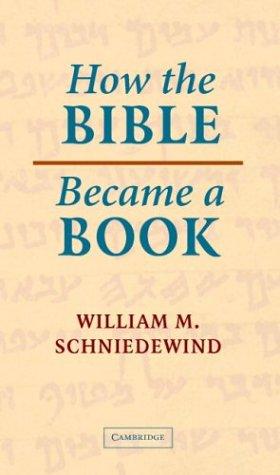
How the Bible Became a Book
0
0
As an Amazon Associate and affiliate partner, Menrva Books earns from qualifying purchases. Learn more
Author Description
For the past two hundred years biblical scholars have increasingly assumed that the Hebrew Bible was largely written and edited in the Persian and Hellenistic periods. As a result, the written Bible has dwelled in an historical vacuum. Recent archaeological evidence and insights from linguistic anthropology, however, point to the earlier era of the late-Iron Age as the formative period for the writing of biblical literature. How the Bible Became a Book combines these recent archaeological discoveries in the Middle East with insights culled from the history of writing to address how the Bible first came to be written down and then became sacred Scripture. This book provides rich insight into why these texts came to have authority as Scripture and explores why Ancient Israel, an oral culture, began to write literature, challenging the assertion that widespread literacy first arose in Greece during the fifth century BCE.
Menrva's Summary
THE THESIS
The Bible's origins are re-examined through the lens of Iron Age writing practices and recent archaeological findings. William M. Schniedewind, a scholar of Ancient Near Eastern languages and literature, challenges the prevailing scholarly consensus that the Hebrew Bible was primarily written and edited in the Persian and Hellenistic periods. Instead, he argues that the late Iron Age was the crucial formative period for biblical literature, drawing on new archaeological evidence from the Middle East and insights into the history of writing. This work explores how these texts acquired their scriptural authority and questions the notion that widespread literacy originated in Greece, proposing that Ancient Israel, despite being an oral culture, began to produce literature much earlier.
THE SCOPE MAP
- Re-evaluation of the dating and authorship of the Hebrew Bible.
- Integration of recent archaeological discoveries from the Middle East.
- Analysis of the history of writing and its impact on textual development.
- Exploration of the transition from oral culture to written literature in Ancient Israel.
- Challenging the traditional timeline for the development of widespread literacy.
- Examination of how biblical texts acquired their authority as Scripture.
- Discussion of the linguistic and anthropological factors influencing early writing.
THE AUTHORITY PERSPECTIVE
The book challenges the long-held scholarly view that the Hebrew Bible was largely a product of the Persian and Hellenistic periods, proposing instead that the late Iron Age was its formative era. It synthesizes recent archaeological findings with the history of writing to explain the genesis of biblical literature and its subsequent canonization. The work aims to illuminate why these texts came to be regarded as authoritative Scripture and questions the established narrative of literacy's origins. By examining Ancient Israel's shift from an oral to a literary culture, Schniedewind offers a new perspective on the development of the Bible.
Page Count:
272
Publication Date:
2005-01-01
ISBN-10:
0521536227
ISBN-13:
9780521536226
Religion
Non-Fiction
History
Ancient History
Archaeology
Linguistics
Community Tags
Similar Books














