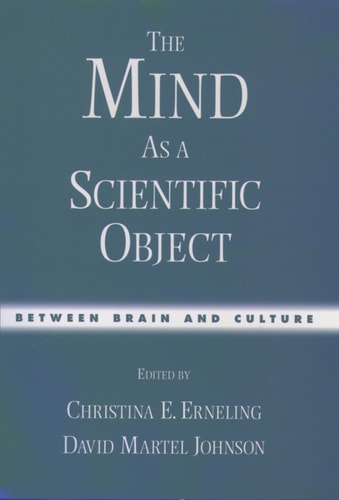
The Mind as a Scientific Object: Between Brain and Culture
0
0
As an Amazon Associate and affiliate partner, Menrva Books earns from qualifying purchases. Learn more
Author Description
What holds together the various fields that are supposed to consititute the general intellectual discipline that people now call cognitive science? In this book, Erneling and Johnson identify two problems with defining this discipline. First, some theorists identify the common subject matter as the mind, but scientists and philosophers have not been able to agree on any single, satisfactory answer to the question of what the mind is. Second, those who speculate about the general characteristics that belong to cognitive science tend to assume that all the particular fields falling under the rubric--psychology, linguistics, biology, and son on--are of roughly equal value in their ability to shed light on the nature of mind. This book argues that all the cognitive science disciplines are not equally able to provide answers to ontological questions about the mind, but rather that only neurophysiology and cultural psychology are suited to answer these questions. However, since the cultural account of mind has long been ignored in favor of the neurophysiological account, Erneling and Johnson bring together contributions that focus especially on different versions of the cultural account of the mind.
Menrva's Summary
THE THESIS
This book investigates the foundational question of what constitutes the discipline of cognitive science and how its disparate fields can be reconciled. The authors, Christina E. Erneling and David T. Johnson, challenge the assumption that all cognitive science sub-disciplines contribute equally to understanding the mind. They argue that the field suffers from a lack of consensus regarding the definition of the mind and propose that neurophysiology and cultural psychology are the primary disciplines capable of addressing ontological questions about human cognition.
THE SCOPE MAP
What You Will Find
- A critical analysis of the interdisciplinary structure of cognitive science
- A comparative evaluation of neurophysiological versus cultural psychological frameworks
- Theoretical arguments regarding the ontological status of the mind
Scope Limits
- The text does not provide a comprehensive overview of all sub-fields within cognitive science
- It does not offer empirical laboratory data but focuses on conceptual and philosophical synthesis
THE AUTHORITY PERSPECTIVE
Scholars and students of cognitive science frequently cite this work for its rigorous critique of the field's internal coherence. Experts highlight the text as a significant contribution to the debate regarding the marginalization of cultural perspectives in favor of purely biological models of the mind.
Page Count:
563
Publication Date:
2005-01-01
Publisher:
Oxford University Press
ISBN-10:
0190286083
ISBN-13:
9780190286088
Philosophy of
Neuroscience
Epistemology
Community Tags
Similar Books