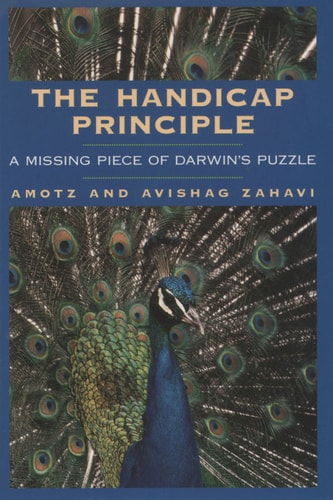
The Handicap Principle: A Missing Piece of Darwin's Puzzle
0
0
As an Amazon Associate and affiliate partner, Menrva Books earns from qualifying purchases. Learn more
Author Description
Ever since Darwin, animal behavior has intrigued and perplexed human observers. The elaborate mating rituals, lavish decorative displays, complex songs, calls, dances and many other forms of animal signaling raise fascinating questions. To what degree can animals communicate within their own species and even between species? What evolutionary purpose do such communications serve? Perhaps most importantly, what can animal signaling tell us about our own non-verbal forms of communication? In The Handicap Principle, Amotz and Ashivag Zahavi offer a unifying theory that brilliantly explains many previously baffling aspects of animal signaling and holds up a mirror in which ordinary human behaviors take on surprising new significance.The wide-ranging implications of the Zahavis' new theory make it arguably the most important advance in animal behavior in decades. Based on 20 years of painstaking observation, the Handicap Principle illuminates an astonishing variety of signaling behaviors in animals ranging from ants and ameba to peacocks and gazelles. Essentially, the theory asserts that for animal signals to be effective they must be reliable, and to be reliable they must impose a cost, or handicap, on the signaler. When a gazelle sights a wolf, for instance, and jumps high into the air several times before fleeing, it is signaling, in a reliable way, that it is in tip-top condition, easily able to outrun the wolf. (A human parallel occurs in children's games of tag, where faster children will often taunt their pursuer before running). By momentarily handicapping itself--expending precious time and energy in this display--the gazelle underscores the truthfulness of its signal. Such signaling, the authors suggest, serves the interests of both predator and prey, sparing each the exhaustion of a pointless chase. Similarly, the enormous cost a peacock incurs by carrying its elaborate and weighty tail-feathers, which interfere with food gathering, reliably communicates its v
Menrva's Summary
THE THESIS
The Handicap Principle posits that for animal signals to be evolutionarily effective, they must be reliable, and to be reliable, they must impose a significant cost or handicap on the signaler. Amotz and Avishag Zahavi, both distinguished biologists, synthesize two decades of field observation to challenge traditional interpretations of animal communication. They argue that costly displays, such as the peacock's tail or a gazelle's stotting, serve as honest indicators of fitness that benefit both the signaler and the receiver by preventing deceptive signaling.
THE SCOPE MAP
What You Will Find
- A comprehensive framework for understanding biological signaling and honest communication.
- Analysis of diverse animal behaviors ranging from microscopic organisms to complex mammals.
- Theoretical applications of the handicap principle to human non-verbal communication and social interaction.
Scope Limits
- The text focuses primarily on evolutionary biology and does not provide an exhaustive survey of psychological or sociological theories of human communication.
THE AUTHORITY PERSPECTIVE
Experts in evolutionary biology recognize this work as a foundational text that fundamentally shifted the discourse on sexual selection and signaling theory. Readers frequently note the density of the biological arguments, yet highlight the clarity with which the authors connect complex evolutionary mechanisms to observable animal behaviors.
Page Count:
287
Publication Date:
1999-01-01
Publisher:
Oxford University Press
ISBN-10:
0190284587
ISBN-13:
9780190284589
Nature
Non-Fiction
Science
Altruism
Zoology
People with Disabilities
Evolution
Evolutionary Biology
Community Tags
Similar Books










Reader Comments
Share Your Thoughts
No comments yet. Be the first to share your thoughts!