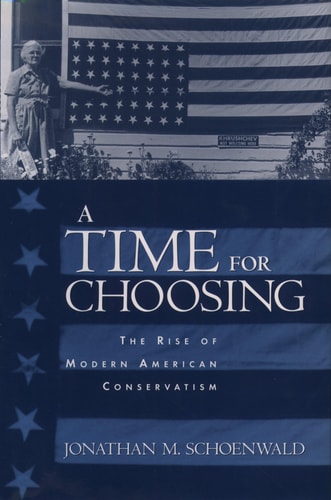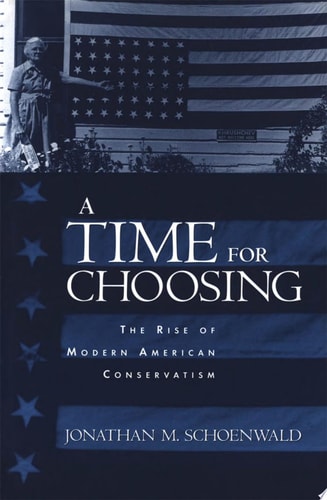
A Time for Choosing: The Rise of Modern American Conservatism
0
0
As an Amazon Associate and affiliate partner, Menrva Books earns from qualifying purchases. Learn more
Author Description
How did American conservatism, little more than a collection of loosely related beliefs in the late 1940s and early 1950s, become a coherent political and social force in the 1960s? What political strategies originating during the decade enabled the modern conservative movement to flourish? And how did mainstream and extremist conservatives, frequently at odds over tactics and ideology, each play a role in reshaping the Republican Party? In the 1960s conservatives did nothing less than engineer their own revolution. A Time for Choosing tells the remarkable story behind this transformation. Where previous accounts of conservatism's rise tend to speed from 1964 through the start of the Reagan era in 1980, A Time for Choosing explores in dramatic detail how conservatives took immediate action following the Goldwater debacle. William F. Buckley, Jr.'s 1965 bid for Mayor of New York City and Reagan's 1966 California governor's campaign helped turn the tide for electoral conservatism. By decade's end, independent "splinter groups" vied for the right to bear the conservative standard into the next decade, demonstrating the movement's strength and vitality. Although conservative ideology was not created during the 1960s, its political components were. Here, then, is the story of the rise of the modern conservative movement. Provocative and beautifully written, A Time for Choosing is a book for anyone interested in politics and history in the postwar era.
Menrva's Summary
THE THESIS
This book investigates how American conservatism transitioned from a fragmented collection of beliefs in the late 1940s into a cohesive, influential political force during the 1960s. Jonathan Schoenwald, a historian specializing in American political movements, utilizes archival research and political analysis to argue that the modern conservative movement was forged through specific electoral strategies and internal ideological negotiations following the 1964 Goldwater defeat. The text examines how various factions, ranging from mainstream Republicans to more radical elements, navigated tactical disagreements to reshape the American political landscape.
THE SCOPE MAP
What You Will Find
- Analysis of the post-Goldwater conservative political strategy
- Examination of the 1965 New York City mayoral campaign of William F. Buckley, Jr.
- Assessment of Ronald Reagan's 1966 California gubernatorial campaign
- Documentation of the rise of independent conservative splinter groups
- Evaluation of the internal tensions between mainstream and extremist conservative factions
Scope Limits
- The book focuses primarily on the 1960s and does not provide an exhaustive history of the Reagan presidency or the post-1980 era.
THE AUTHORITY PERSPECTIVE
Scholars and political historians frequently cite this work as a significant contribution to understanding the organizational mechanics of the American Right. Readers often note the academic rigor of the prose, which provides a detailed look at the tactical evolution of conservative political mobilization.
Page Count:
348
Publication Date:
2001-01-01
Publisher:
Oxford University Press
ISBN-10:
0190285508
ISBN-13:
9780190285500
History
Right and left Political science
Conservatism
20th Century
American History
Political Biography
Radicalism