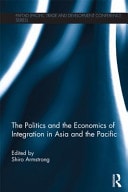
Politics and the Economics of Integration in Asia and the Pacific
0
0
As an Amazon Associate and affiliate partner, Menrva Books earns from qualifying purchases. Learn more
Author Description
The shape of economic integration in the global and regional economies--and the extent to which goods, services and factors of production move more or less freely across borders--depends not only upon underlying economic conditions but also upon politics. Whether integration is market-led, as has been the case in Asia, or institution-led as in Europe, there are political elements that affect all forms of regional and international economic integration. While geopolitics influences international economic integration, so too does domestic politics. Economic integration in Asia has been driven by rapid unilateral trade and investment liberalization and, while trade and investment patterns have been determined largely by comparative advantage, political forces have also affected patterns of economic interdependence. The form that regional institutions take, and their effectiveness, also depends on political relations between countries. The particular circumstances in Asia, and the relationships between regional economies has profoundly shaped regional institutions and will continue to do so. The chapters in this volume draw on papers originally presented to the 33rd Pacific Trade and Development Conference held in Taipei in 2009 to look in original ways at how politics shape economic integration and its various dimensions in Asia and the Pacific and globally.
Menrva's Summary
THE THESIS
This volume investigates how political dynamics, both domestic and geopolitical, fundamentally shape the trajectory and effectiveness of economic integration within the Asia-Pacific region. Shiro Armstrong, an expert in international trade and regional economic policy, compiles research that challenges the notion that economic integration is purely a market-driven phenomenon. By analyzing the interplay between unilateral liberalization and institutional frameworks, the text argues that political relations are the primary determinants of how regional economies interact and structure their cooperation.
THE SCOPE MAP
What You Will Find
- Analysis of the distinction between market-led integration in Asia versus institution-led integration in Europe.
- Examination of how domestic politics and geopolitical tensions influence trade and investment liberalization.
- Case studies and research papers derived from the 33rd Pacific Trade and Development Conference.
- Evaluation of the effectiveness of regional institutions in the context of shifting international political relations.
THE AUTHORITY PERSPECTIVE
Experts recognize this volume as a significant contribution to the study of regional economic policy, particularly for its focus on the often-overlooked political underpinnings of trade. Readers frequently note the academic density of the prose, which serves as a foundational resource for scholars and policymakers interested in the intersection of political science and international economics.
Page Count:
209
Publication Date:
2011-01-01
Publisher:
Routledge
ISBN-10:
0203157672
ISBN-13:
9780203157671
Economics
Trade
International relations
Asia
Globalization