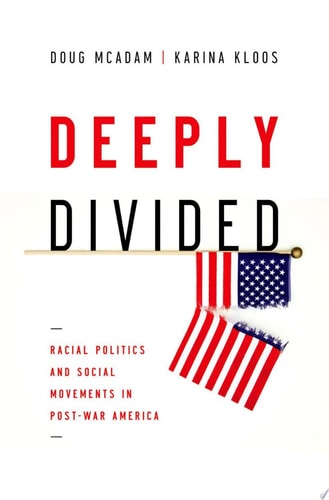
Deeply Divided: Racial Politics and Social Movements in Post-War America
0
0
As an Amazon Associate and affiliate partner, Menrva Books earns from qualifying purchases. Learn more
Author Description
By many measures--commonsensical or statistical--the United States has not been more divided politically or economically in the last hundred years than it is now. How have we gone from the striking bipartisan cooperation and relative economic equality of the war years and post-war period to the extreme inequality and savage partisan divisions of today? In this sweeping look at American politics from the Depression to the present, Doug McAdam and Karina Kloos argue that party politics alone is not responsible for the mess we find ourselves in. Instead, it was the ongoing interaction of social movements and parties that, over time, pushed Democrats and Republicans toward their ideological margins, undermining the post-war consensus in the process. The Civil Rights struggle and the white backlash it provoked reintroduced the centrifugal force of social movements into American politics, ushering in an especially active and sustained period of movement/party dynamism, culminating in today's tug of war between the Tea Party and Republican establishment for control of the GOP. In Deeply Divided, McAdam and Kloos depart from established explanations of the conservative turn in the United States and trace the roots of political polarization and economic inequality back to the shifting racial geography of American politics in the 1960s. Angered by Lyndon Johnson's more aggressive embrace of civil rights reform in 1964, Southern Dixiecrats abandoned the Democrats for the first time in history, setting in motion a sustained regional realignment that would, in time, serve as the electoral foundation for a resurgent and increasingly more conservative Republican Party.
Menrva's Summary
THE THESIS
This book investigates how the interaction between social movements and political parties has driven the extreme ideological polarization and economic inequality observed in contemporary American society. Doug McAdam and Karina Kloos, both established scholars in sociology and political science, utilize a historical framework to challenge the notion that party politics alone created the current divide. By analyzing the period from the Great Depression to the present, they argue that the reintroduction of social movements into the political arena—specifically the Civil Rights movement and the subsequent white backlash—fundamentally altered the trajectory of American governance. The authors demonstrate how this movement-party dynamism pushed both major parties toward their ideological margins, effectively dismantling the post-war consensus.
THE SCOPE MAP
What You Will Find
- A longitudinal analysis of American political realignment from the 1930s to the present day.
- An examination of the shifting racial geography of American politics following the 1964 Civil Rights reforms.
- Evidence derived from historical political data, electoral shifts, and the study of social movement dynamics.
- A detailed account of the Southern Dixiecrat transition and its role in the rise of a more conservative Republican Party.
THE AUTHORITY PERSPECTIVE
Experts recognize this work as a significant contribution to the study of political sociology, particularly for its focus on the structural origins of modern polarization. Readers frequently note the academic rigor of the prose, which provides a clear, evidence-based alternative to standard partisan narratives of American history.
Page Count:
408
Publication Date:
2014-01-01
Publisher:
Oxford University Press
ISBN-10:
0199394261
ISBN-13:
9780199394265
History
Civil Rights
Special Topics
American Government
Sociology
American History
Community Tags
Other Editions(2)

Similar Books