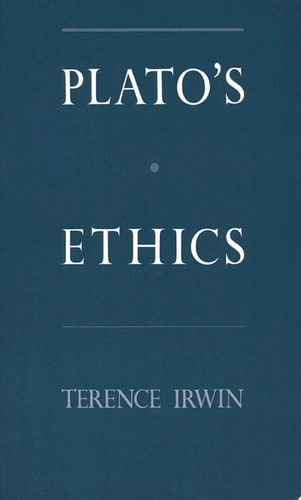
Plato's Ethics
0
0
As an Amazon Associate and affiliate partner, Menrva Books earns from qualifying purchases. Learn more
Author Description
This exceptional book examines and explains Plato's answer to the normative question, "How ought we to live?" It discusses Plato's conception of the virtues; his views about the connection between the virtues and happiness; and the account of reason, desire, and motivation that underlies his arguments about the virtues. Plato's answer to the epistemological question, "How can we know how we ought to live?" is also discussed. His views on knowledge, belief, and inquiry, and his theory of Forms, are examined, insofar as they are relevant to his ethical view. Terence Irwin traces the development of Plato's moral philosophy, from the Socratic dialogues to its fullest exposition in the Republic. Plato's Ethics discusses Plato's reasons for abandoning or modifying some aspects of Socratic ethics, and for believing that he preserves Socrates' essential insights. A brief and selective discussion of the Statesmen, Philebus, and Laws is included. Replacing Irwin's earlier Plato's Moral Theory (Oxford, 1977), this book gives a clearer and fuller account of the main questions and discusses some recent controversies in the interpretation of Plato's ethics. It does not presuppose any knowledge of Greek or any extensive knowledge of Plato.
Menrva's Summary
THE THESIS
This book investigates the core normative and epistemological questions regarding how one ought to live as presented throughout the dialogues of Plato. Terence Irwin, a prominent scholar of ancient philosophy, utilizes a systematic analysis of Plato's evolving moral framework to explain the connection between virtue, happiness, and human motivation. By tracing the progression from Socratic inquiry to the mature theory of Forms, the author provides a comprehensive account of how Plato justifies his ethical conclusions.
THE SCOPE MAP
What You Will Find
- A chronological analysis of Plato's moral philosophy from the Socratic dialogues to the Republic.
- An examination of the relationship between reason, desire, and the theory of Forms.
- A comparative study of Socratic ethics versus later Platonic developments.
Scope Limits
- The text does not provide an exhaustive commentary on every Platonic dialogue.
- It does not require the reader to possess prior knowledge of the Greek language.
THE AUTHORITY PERSPECTIVE
Scholars and students frequently cite this work as a primary resource for understanding the development of Platonic ethics. Readers often note the clarity of the prose, which makes complex philosophical arguments accessible to those without an extensive background in the subject.
Page Count:
454
Publication Date:
1995-01-01
Publisher:
Oxford University Press
ISBN-10:
0190282150
ISBN-13:
9780190282158
Philosophy
History & Surveys
Ethics
Plato
Moral Philosophy
Community Tags
Similar Books