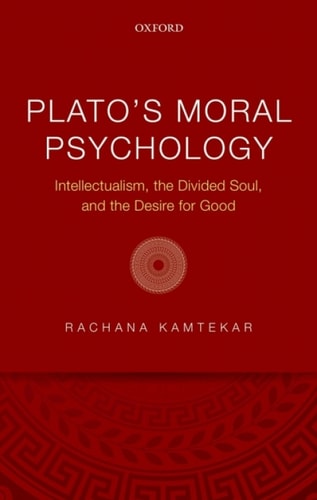
Plato's Moral Psychology: Intellectualism, the Divided Soul, and the Desire for Good
0
0
As an Amazon Associate and affiliate partner, Menrva Books earns from qualifying purchases. Learn more
Author Description
Plato's Moral Psychology is concerned with Plato's account of the soul and its impact on our living well or badly, virtuously or viciously. The core of Plato's moral psychology is his account of human motivation, and Rachana Kamtekar argues that throughout the dialogues Plato maintains that human beings have a natural desire for our own good, and that actions and conditions contrary to this desire are involuntary (from which follows the 'Socratic paradox' that wrongdoing is involuntary). Our natural desire for our own good may be manifested in different ways: by our pursuit of what we calculate is best, but also by our pursuit of pleasant or fine things - pursuits which Plato assigns to distinct parts of the soul. Kamtekar develops a very different interpretation of Plato's moral psychology from the mainstream interpretation, according to which Plato first proposes that human beings only do what we believe to be the best of the things we can do ('Socratic intellectualism') and then in the middle dialogues rejects this in favour of the view that the soul is divided into parts with some good-dependent and some good-independent motivations ('the divided soul').
Menrva's Summary
THE THESIS
This book investigates the core question of how Plato accounts for human motivation and the relationship between the soul and moral action. Rachana Kamtekar, a scholar of ancient philosophy, utilizes a close reading of the Platonic dialogues to challenge the traditional scholarly view that Plato shifted from Socratic intellectualism to a theory of a divided soul. She argues instead for a consistent framework where human beings possess a natural, persistent desire for their own good, which manifests through various psychological faculties.
THE SCOPE MAP
What You Will Find
- Analysis of the Socratic paradox regarding involuntary wrongdoing.
- Examination of the tripartite soul model in the middle dialogues.
- Comparison of good-dependent and good-independent motivations.
- Re-evaluation of the transition between early and middle Platonic dialogues.
Scope Limits
- The text does not provide a comprehensive biography of Plato.
- The analysis focuses primarily on moral psychology rather than Plato's political theory or metaphysics.
THE AUTHORITY PERSPECTIVE
Scholars recognize this work as a significant contribution to the study of Platonic ethics, particularly for its challenge to the standard developmentalist interpretation of Plato's thought. Readers frequently note the academic density of the prose, which is intended for students and researchers of ancient philosophy.
Page Count:
240
Publication Date:
2017-01-01
Publisher:
OUP Oxford
ISBN-10:
0192519387
ISBN-13:
9780192519382
Philosophy
History & Surveys
Ethics
Plato
Community Tags
Similar Books