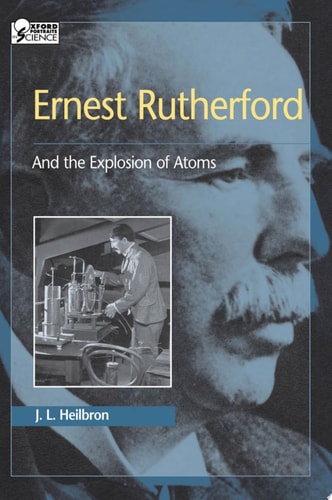
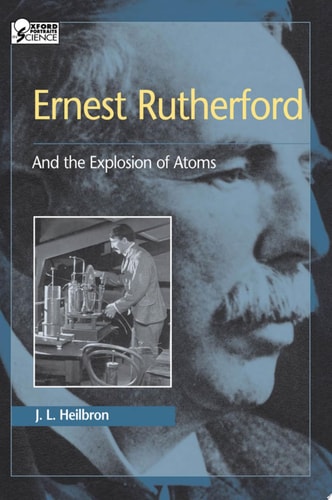
Ernest Rutherford: And the Explosion of Atoms
0
0
As an Amazon Associate and affiliate partner, Menrva Books earns from qualifying purchases. Learn more
Author Description
An engaging biography that captures the excitement of the early days of nuclear physics, Ernest Rutherford tells the story of the down-to-earth New Zealander who became one of the foremost pioneers of subatomic physics. Rutherford's achievements were numerous and included:* Inventing a detector for electromagnetic waves* Discovering the existence of alpha and beta rays in uranium radiation* Creating (with Frederick Soddy) the "disintegration theory" of radioactivity, which regards radioactive phenomena as atomic -- not molecular -- processes * Demonstrating that the inner structures of elements correspond with a group of lines that characterize them, which could then be assigned an atomic number and, more important, the properties of each element could be defined by this number * And his greatest contribution of all - he discovered that the atom had a nucleus and that it contained the positively charged proton From his early days as a scholarship student to the end of his life as he continued to work in his lab, Ernest Rutherford reveals the life and times of one of the greatest minds of the twentieth century.Oxford Portraits in Science is an on-going series of scientific biographies for young adults. Written by top scholars and writers, each biography examines the personality of its subject as well as the thought process leading to his or her discoveries. These illustrated biographies combine accessible technical information with compelling personal stories to portray the scientists whose work has shaped our understanding of the natural world.
Menrva's Summary
THE THESIS
This biography investigates how Ernest Rutherford’s experimental methodology and conceptual breakthroughs fundamentally altered the scientific understanding of atomic structure. Author J. L. Heilbron, a historian of science, utilizes primary source documents and historical context to trace Rutherford's transition from a scholarship student in New Zealand to a central figure in twentieth-century physics. The text argues that Rutherford's specific approach to radioactivity and nuclear theory provided the necessary framework for modern subatomic physics.
THE SCOPE MAP
What You Will Find
- Detailed accounts of Rutherford's early experiments with electromagnetic waves and uranium radiation.
- Explanations of the disintegration theory of radioactivity developed with Frederick Soddy.
- Analysis of the discovery of the atomic nucleus and the identification of the proton.
- Biographical context regarding Rutherford's academic career and laboratory environment.
Scope Limits
- The text does not provide an exhaustive technical manual for advanced nuclear physics calculations.
- It focuses primarily on Rutherford's professional contributions rather than an intimate psychological profile of his private life.
THE AUTHORITY PERSPECTIVE
Experts recognize this work as a reliable and accessible entry point for students interested in the history of nuclear physics. Readers frequently note that the prose balances technical clarity with historical narrative, making it a standard resource for those seeking to understand the foundational figures of modern science.
Page Count:
138
Publication Date:
2003-01-01
Publisher:
Oxford University Press
ISBN-10:
0190284196
ISBN-13:
9780190284190
Biography
Non-Fiction
Science
Science History
English
Physics
English & College Success
Community Tags
Other Editions(4)


Similar Books













Reader Comments
Share Your Thoughts
No comments yet. Be the first to share your thoughts!