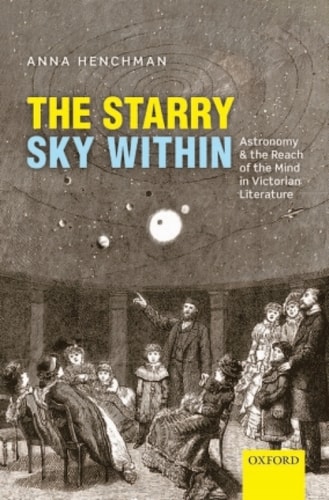
The Starry Sky Within: Astronomy and the Reach of the Mind in Victorian Literature
0
0
As an Amazon Associate and affiliate partner, Menrva Books earns from qualifying purchases. Learn more
Author Description
Tracing unexplored connections between nineteenth-century astronomy and literature, The Starry Sky Within offers a new understanding of literary point of view as essentially multiple, mobile, and comparative. Nineteenth-century astronomy revealed a cosmos of celestial systems in constant motion. Stars, comets, planets, and moons coursed through space in complex and changing relation. As the skies were in motion, so too was the human subject. Astronomers showed that human beings never perceive the world from a stable position. The mobility of our bodies in space and the very structure of stereoscopic vision mean that point of view is neither singular nor stable. We always see the world as an amalgam of fractured perspectives. In this innovative study, Henchman shows that the reconceptualization of the skies gave poets and novelists new spaces in which to indulge their longing to escape the limitations of individual perspective. She links astronomy and optics to the form of the multiplot novel, with its many centers of consciousness, complex systems of relation, and criss-crossing points of view. Accounts of a world and a subject both in relative motion shaped the form of grand-scale narratives such as Tess of the D'Urbervilles, Bleak House, and Daniel Deronda. De Quincey, Tennyson, and Eliot befriended leading astronomers and visited observatories, while Hardy learned about astronomy from the vast popular literature of the day. These writers use cosmic distances to dislodge their readers from the earth, setting human perception against views from high above and then telescoping back to earth again. What results is a new perception of the mobility of point of view in both literature and science.
Menrva's Summary
THE THESIS
This book investigates how nineteenth-century astronomical discoveries regarding a dynamic, mobile cosmos fundamentally reshaped the narrative structure and point-of-view techniques in Victorian literature. Author Anna Henchman, a scholar of Victorian literature and science, utilizes a cross-disciplinary framework to argue that the era's shift toward understanding the universe as a system of constant motion influenced how novelists and poets conceptualized the human subject. By examining the intersection of optics, astronomy, and literary form, Henchman demonstrates that writers adopted cosmic perspectives to challenge the limitations of singular, stable human perception.
THE SCOPE MAP
What You Will Find
- Analysis of the influence of nineteenth-century astronomical concepts on literary form.
- Examination of the multiplot novel as a reflection of complex celestial systems.
- Case studies of works by Thomas Hardy, George Eliot, Alfred Tennyson, and Thomas De Quincey.
- Exploration of the relationship between stereoscopic vision and narrative point of view.
Scope Limits
- The study focuses primarily on British Victorian literature and does not extend to twentieth-century modernist narrative shifts.
- The analysis is limited to the specific intersection of astronomy and literary form rather than a comprehensive history of Victorian science.
THE AUTHORITY PERSPECTIVE
Scholars and critics recognize this work as a significant contribution to the field of literature and science studies, noting its ability to bridge the gap between technical astronomical history and literary analysis. Readers frequently highlight the clarity of the author's prose and the depth of her research into the personal connections between Victorian writers and contemporary astronomers.
Page Count:
320
Publication Date:
2014-01-01
Publisher:
OUP Oxford
ISBN-10:
0191510572
ISBN-13:
9780191510571
Science History
Astronomy
English
Victorian
Literary Criticism
English & College Success
Community Tags
Similar Books