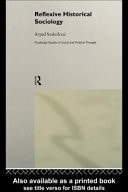
Reflexive Historical Sociology
0
0
As an Amazon Associate and affiliate partner, Menrva Books earns from qualifying purchases. Learn more
Author Description
This Book Reconstructs And Brings Together The Work Of A Number Of Social And Political Theorists In Order To Gain New Insight On The Emergence And Character Of Modern Western Society. It Examines The Intersection Point Of Social Theory And Historical Sociology In A New Theoretical Approach Called Reflexive Historical Sociology. There Is Analysis Of The Works Of Max Weber, Michel Foucault, Norbert Elias, Eric Voegelin And A Number Of Others. The Book Is Divided Into Three Parts. Part 1 Examines The Works Of Eric Voegelin, Norbert Elias, Lewis Mumford And Franz Borkenau. Part 2 Is Concerned With The Major Conceptual Tools Such As Experience, Liminality, Process, Symbolisation, Figuration, Order, Dramatisation And Reflexivity, And Themes Such As The History Of Forms Of Thought, Subjectivity, Knowledge And Closed Space And Regulated Time. Finally, The Book Examines The Most Important Insights Of The Thinkers Discussed, Concerning The Historical Processes That Led To Modernity.
Menrva's Summary
THE THESIS
This book investigates the emergence and character of modern Western society by establishing a new theoretical framework known as Reflexive Historical Sociology. Arpad Szakolczai, a scholar of social and political theory, synthesizes the contributions of influential thinkers to bridge the gap between social theory and historical analysis. By evaluating the conceptual tools and historical insights of figures such as Max Weber, Michel Foucault, and Eric Voegelin, the author constructs a methodology for understanding the historical processes that shaped modernity. The work serves as a comprehensive re-evaluation of how social forms and subjective experiences have evolved over time.
THE SCOPE MAP
What You Will Find
- A comparative analysis of the theoretical contributions of Eric Voegelin, Norbert Elias, Lewis Mumford, and Franz Borkenau.
- An examination of core conceptual tools including liminality, figuration, dramatisation, and reflexivity.
- A thematic exploration of the history of thought, subjectivity, and the regulation of time and space.
- A structured inquiry into the historical processes that facilitated the transition into modern Western society.
THE AUTHORITY PERSPECTIVE
Experts recognize this work as a dense, scholarly contribution to the field of historical sociology that demands significant familiarity with classical social theory. Readers frequently note the academic rigor of the prose and the author's ambitious attempt to synthesize disparate intellectual traditions into a unified analytical approach.
Page Count:
304
Publication Date:
2003-01-01
Publisher:
Taylor & Francis Group
ISBN-10:
020319361X
ISBN-13:
9780203193617
History
Philosophy
Social Theory
Political Theory
Civilization philosophy
Sociology
Community Tags
Similar Books