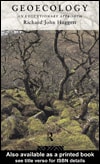
Geoecology
0
0
As an Amazon Associate and affiliate partner, Menrva Books earns from qualifying purchases. Learn more
Author Description
Animals, plants and soils interact with one another. They also interact with the terrestrial spheres - the atmosphere, hydrosphere, toposphere, and lithoshpere - and with the rest of the Cosmos. On land, this rich interaction creates landscape systems or geoecosystems. Geoecology investigates the structure and function of geoecosystems. Part one introduces geoecological systems, their nature, hierarchial structure, and ideas about their interdependence and integrity. A simple dynamic systems model, referred to as the `brash' equation, is developed to provide an analytical and conceptual framework for the book. Part two explores internal or `ecological' interactions between geoecosystems and their near-surface environment, with individual chapters looking at the influence of climate, altitude, topography, insularity, and substrate. Part three prospects the role of external factors, both geological and cosmic, as agencies disturbing the dynamics of the geoecosystems. A new `evolutionary' view emerges of geoecological systems, and the animals, plants, and soils comprising them, emerges: geoecosystems are seen as dynamic entities, organized on an hierarchical basis, that perpetually respond to changes within themselves and in their surroundings. Presenting a new ecological and evolutionary approach to the study of geoecological change, Geoecology will interest a wide range of environmental scientists, geographers, ecologists and pedologists.
Menrva's Summary
THE THESIS
This book investigates the structure and function of geoecosystems by analyzing the complex interactions between terrestrial spheres and biological life. Author Richard J. Huggett, a recognized scholar in physical geography, utilizes a dynamic systems model known as the 'brash' equation to provide a conceptual framework for understanding how landscapes evolve. By synthesizing data from climate, topography, and substrate studies, the text argues that geoecosystems are hierarchical, dynamic entities that perpetually respond to internal and external environmental pressures.
THE SCOPE MAP
What You Will Find
- A comprehensive analysis of geoecological systems and their hierarchical structures.
- The application of the 'brash' equation as a dynamic systems modeling tool.
- Examination of ecological interactions influenced by climate, altitude, and topography.
- An evolutionary perspective on how cosmic and geological factors disturb and shape landscape dynamics.
THE AUTHORITY PERSPECTIVE
Experts and environmental scientists frequently cite this work as a foundational text for understanding the integration of pedology, ecology, and geography. Readers often note the academic density of the prose, which is tailored specifically for researchers and students within the earth sciences.
Page Count:
320
Publication Date:
2004-01-01
Publisher:
Taylor & Francis Group Plc
ISBN-10:
0203209249
ISBN-13:
9780203209240
Science
Non-Fiction
Geography
Life sciences
Geology
Biogeomorphology
Nonfiction
Earth Science
Ecology
Biogeography
Community Tags
Similar Books