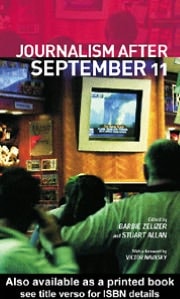
Journalism After September 11
0
0
As an Amazon Associate and affiliate partner, Menrva Books earns from qualifying purchases. Learn more
Author Description
The events of September 11 continue to resonate in powerful, yet sometimes unexpected ways. For many journalists, the crisis has decisively recast their sense of the world around them. Familiar notions of what it means to be a journalist, how best to practice journalism, and what the public can reasonably expect of journalists in the name of democracy, have been shaken to their foundations. Journalism After September 11 examines how the traumatic attacks of that day continue to transform the nature of journalism, particularly in the United States and Britain.
Menrva's Summary
THE THESIS
This book investigates how the terrorist attacks of September 11, 2001, fundamentally altered the professional standards, ethical frameworks, and public expectations of journalism in the United States and Britain. Editors Stuart Allan and Barbie Zelizer compile a series of scholarly essays that analyze the shift in media practices following the crisis. The contributors examine how the trauma of the event forced a re-evaluation of journalistic objectivity, the role of the press in democratic societies, and the tension between national security and the public's right to information. By synthesizing academic perspectives, the text provides a critical look at the evolving landscape of news reporting in a post-9/11 world.
THE SCOPE MAP
What You Will Find
- Comparative analysis of journalistic practices in the United States and Britain.
- Examination of the tension between state-sanctioned narratives and independent reporting.
- Case studies focusing on the shift in media coverage during times of national crisis.
- Theoretical frameworks regarding the role of the journalist as a witness and mediator of trauma.
THE AUTHORITY PERSPECTIVE
Experts and media scholars frequently cite this work as a foundational text for understanding the intersection of trauma, politics, and news media in the early 21st century. Readers often note the academic density of the prose, which serves as a rigorous resource for students and professionals in the field of communication studies.
Page Count:
288
Publication Date:
2003-01-01
Publisher:
Taylor & Francis Group
ISBN-10:
0203218132
ISBN-13:
9780203218136
History
United States
Mass media
Communication
Media Studies
Journalism
Community Tags
Similar Books