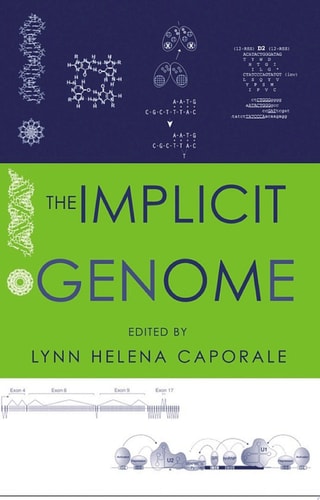
The Implicit Genome
0
0
As an Amazon Associate and affiliate partner, Menrva Books earns from qualifying purchases. Learn more
Author Description
For over half a century, we have been in the thrall of the double-helicaln structure of DNA, which, in an instant, revealed that information can be transferred between generations by a simple rule, A pairs with T, G pairs with C. In its beautiful simplicity, this structure, along with the table of codons worked out in the following decade, had entranced us into believing that we can fully understand the information content of a DNA sequence, simply by treating it as text that is read in a linear fashion. While we have learned much based on this assumption, there is much we have missed. Far from a passive tape running through a reader, genomes contain information that appears in new forms which create regions with distinct behavior. Some are "gene rich", some mobile, some full of repeats and duplications, some sticking together across long evolutionary distances, some readily breaking apart in tumor cells. Even protein-coding regions can carry additional information, taking advantage of the flexible coding options provided by the degeneracy of the genetic code. The chapters in this volume touch on one or more of three interconnected themes; information can be implied, rather than explicit, in a genome; information can lead to focused and/or regulated changes in nucleotide sequences; information that affects the probability of distinct classes of mutation has implications for evolutionary theory.
Menrva's Summary
THE THESIS
This book investigates the limitations of viewing DNA solely as a linear text and proposes that genomes contain complex, implicit information that influences evolutionary processes. Lynn Helena Caporale, a biochemist, challenges the traditional view of the genetic code as a static, passive tape. She argues that the degeneracy of the genetic code and the structural behavior of DNA sequences provide additional layers of information that regulate mutation and evolutionary change.
THE SCOPE MAP
What You Will Find
- Analysis of gene-rich regions and mobile genetic elements
- Examination of the degeneracy of the genetic code and its implications for protein-coding regions
- Discussion on how DNA structure influences mutation probabilities
Scope Limits
- The text does not provide a comprehensive history of the Human Genome Project
- It does not serve as a basic introductory textbook for undergraduate genetics students
THE AUTHORITY PERSPECTIVE
Experts recognize this work as a significant contribution to the discussion on genome complexity beyond simple linear sequencing. Readers frequently note the technical density of the prose, which is best suited for those with a background in molecular biology or genetics.
Page Count:
397
Publication Date:
2006-01-01
Publisher:
Oxford University Press
ISBN-10:
0190291540
ISBN-13:
9780190291549
Non-Fiction
Science
Immunity
Evolutionary Biology
Genetics
Evolutionary genetics
Evolution
Community Tags
Other Editions(3)
Similar Books