The Notion of Heresy in Greek Literature in the Second and Third Centuries
0
0
As an Amazon Associate and affiliate partner, Menrva Books earns from qualifying purchases. Learn more
Author Description
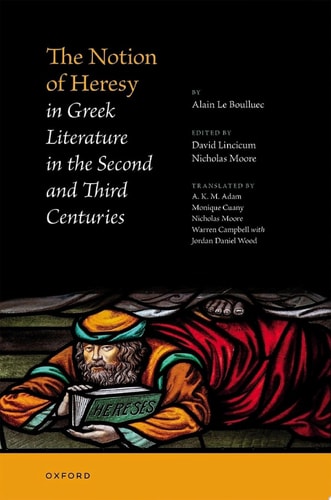
Inspired by analogies betwen the construction of heresy and the representation of madness described by Michael Foucault in in Histoire de la folie à l'âge classique (Madness and Civilization), The Notion of Heresy in Greek Literature in the Second and Third Centuries demonstrates how the concept of heresy emerges in the work of Justin Matyr. It shows that this invention created a concept capable of dominating every current suspected of endangering ecclesial harmony, and transformed the tradition of Greek historiography of philosophical schools by combining it with the apocalyptic theme of diabolical conspiracy. Le Boulluec examines how this model is refined by Irenaeus, then modified by Clement of Alexandria and Origen. First published in 1985 as d'hérésie dans la littérature grecque (IIe-IIIesiècles), this newly translated work includes a substantial new introduction surveying literature in the previous decades. In line wth Walter Bauer's pioneering book, which overturned the confessional model making heresy a later falsification of orthodoxy, it shows that the notion of heresy was invented in the second century and then refined in order to remove all legitimacy from diversity and pluralism in the fields of doctrine and practice. Le Boulluec studies rhetorical practices and polemical assimilations to highlight key debates on the relationship between philosophy, Christianity, and Judaism, and to examine the conflict of interpretations that drive the exegesis of the Bible in constructing an orthodoxy.
Menrva's Summary
THE THESIS
This work investigates the historical invention of the concept of heresy within early Christian literature and its function as a tool for enforcing doctrinal orthodoxy. Alain Le Boulluec, a scholar of patristic studies, utilizes a framework inspired by Michel Foucault’s analysis of madness to examine how second and third-century Christian writers constructed the category of heresy. By analyzing the works of Justin Martyr, Irenaeus, Clement of Alexandria, and Origen, the author argues that the invention of heresy was a deliberate rhetorical and political strategy designed to delegitimize theological pluralism and consolidate ecclesial authority.
THE SCOPE MAP
What You Will Find
- Analysis of the transition from Greek philosophical historiography to Christian polemical writing.
- Examination of the influence of apocalyptic themes on the definition of deviant belief.
- Detailed study of the rhetorical strategies employed by early Church Fathers to marginalize competing interpretations.
Scope Limits
- The study focuses primarily on Greek-language literature and does not provide an exhaustive survey of Latin-language patristic developments.
- The analysis is restricted to the second and third centuries, excluding later developments in the fourth-century conciliar era.
THE AUTHORITY PERSPECTIVE
Scholars recognize this text as a foundational contribution to the study of early Christian orthodoxy and the social construction of religious identity. Readers frequently note the academic density of the prose and the rigorous philological approach applied to the primary source material.
Page Count:
724
Publication Date:
2022-01-01
Publisher:
OUP Oxford
ISBN-10:
0192543857
ISBN-13:
9780192543851
History
Philosophy
Religion
Theology
Historiography
Christianity
Ancient History
Community Tags
Similar Books