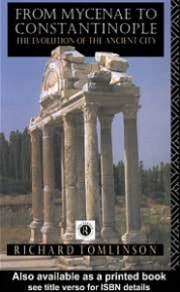
From Mycenae to Constantinople: The Evolution of the Ancient City
0
0
As an Amazon Associate and affiliate partner, Menrva Books earns from qualifying purchases. Learn more
Author Description
Richard A. Tomlinson analyzes the development of the city by examining the architectural remains of urban centers in the Greek and Roman world. He shows how the city is an architectural response to the social organization and varying political systems of its inhabitants. Tomlinson shows how cities served as a base for imperial authority and discusses the circumstances surrounding the creation of a New-Rome for the Christian Empire at Constantinople.
Menrva's Summary
THE THESIS
How did the physical structure of ancient urban centers evolve to reflect the shifting social and political priorities of the Greek and Roman worlds? R. A. Tomlinson, a scholar of classical archaeology, utilizes architectural evidence from major urban sites to argue that city planning is a direct manifestation of the governing systems and social hierarchies of its time. By tracing the development from Mycenaean citadels to the imperial capital of Constantinople, the author provides a framework for understanding the city as a functional tool of political authority.
THE SCOPE MAP
What You Will Find
- Architectural analysis of urban remains from the Mycenaean period through the late Roman Empire.
- Examination of the relationship between public space and political organization.
- Case studies of specific urban centers including Athens, Rome, and Constantinople.
- Discussion on the transition of urban design to accommodate Christian imperial ideology.
THE AUTHORITY PERSPECTIVE
Experts recognize this work as a foundational text for students of classical urbanism due to its clear synthesis of archaeological data and political history. Readers frequently note the accessible nature of the prose, which balances technical architectural detail with broader historical context.
Page Count:
256
Publication Date:
2002-01-01
Publisher:
Taylor & Francis Group
ISBN-10:
0203412907
ISBN-13:
9780203412909
Architecture
History
Archaeology
Cities And Towns
Urban Studies
Ancient History
Community Tags
Similar Books