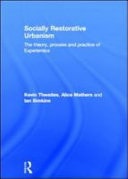
Socially Restorative Urbanism: The Theory, Process and Practice of Experiemics
0
0
As an Amazon Associate and affiliate partner, Menrva Books earns from qualifying purchases. Learn more
Author Description
The Need For A Human-orientated Approach To Urbanism Is Well Understood, And Yet All Too Often This Dimension Remains Lacking In Urban Design. In This Book The Authors Argue For And Develop Socially Restorative Urbanism - A New Conceptual Framework Laying The Foundations For Innovative Ways Of Thinking About The Relationship Between The Urban Spatial Structure And Social Processes To Re-introduce A More Explicit People-centred Element Into Urban Place-making And Its Adaptation. Focusing On This Interplay Between Humans And The Built Environment, Two New Concepts Are Developed: The Transitional Edge - A Socio-spatial Concept Of The Urban Realm; And Experiemics - A Participative Process That Acts To Redress Imbalances In Territorial Relationships, Defined In Terms Of The Awareness Of Mine, Theirs, Ours And Yours (mtoy). In This Way, Socially Restorative Urbanism Shows How Professional Practice And Community Understanding Can Be Brought Together In A Mutually Interdependent And Practical Way. Its Theoretical And Practical Principles Are Applicable Across A Wide Range Of Contexts Concerning Human Benefit Through Urban Environmental Change And Experience, And It Will Be Of Interest To Readers In The Social Sciences And Environmental Psychology, As Well As The Spatial Planning And Design Disciplines. Beyond Boundaries: Developing The Concept Of Socially Restorative Urbanism -- New Age-ing Cities: In Search Of A New Discipline For Socially Oriented Urban Design -- Balance Of Control At The Margins -- The Socially Restorative Urban Environment -- In Search Of The Edge -- The Edge As Socio-spatial Concept -- Transitional Edge Anatomy: Laterality, Extent And Locality -- Experiemics -- The Need For Participative Processes -- Experiemics Development Conclusions. Kevin Thwaites, Alice Mathers And Ian Simkins. Includes Bibliographical References And Index.
Menrva's Summary
THE THESIS
This book investigates how urban design can be reoriented to prioritize human-centric social restoration through a new conceptual framework. The authors, drawing on expertise in urban design and environmental psychology, argue that current spatial planning often neglects the social processes inherent in place-making. They propose 'Socially Restorative Urbanism' as a methodology to bridge the gap between professional practice and community experience, utilizing the built environment to foster healthier social interactions.
THE SCOPE MAP
What You Will Find
- A theoretical framework for the 'Transitional Edge' as a socio-spatial concept in urban environments.
- The 'Experiemics' methodology, a participative process designed to balance territorial relationships.
- Analysis of the 'MTOY' (Mine, Theirs, Ours, Yours) awareness model for community engagement.
- Case studies and practical applications for urban designers, planners, and social scientists.
THE AUTHORITY PERSPECTIVE
Experts in urban design and environmental psychology identify this work as a significant contribution to the discourse on human-oriented spatial planning. Readers frequently note the academic density of the prose, which serves as a foundational text for professionals seeking to integrate social processes into physical design.
Page Count:
246
Publication Date:
2013-01-01
Publisher:
Taylor & Francis Group
ISBN-10:
0415596025
ISBN-13:
9780203467497
Architecture
Landscapes
Environmental Psychology
urban planning
Urban Design
Social Science
Community Tags
Other Editions(2)

Similar Books


Reader Comments
Share Your Thoughts
No comments yet. Be the first to share your thoughts!