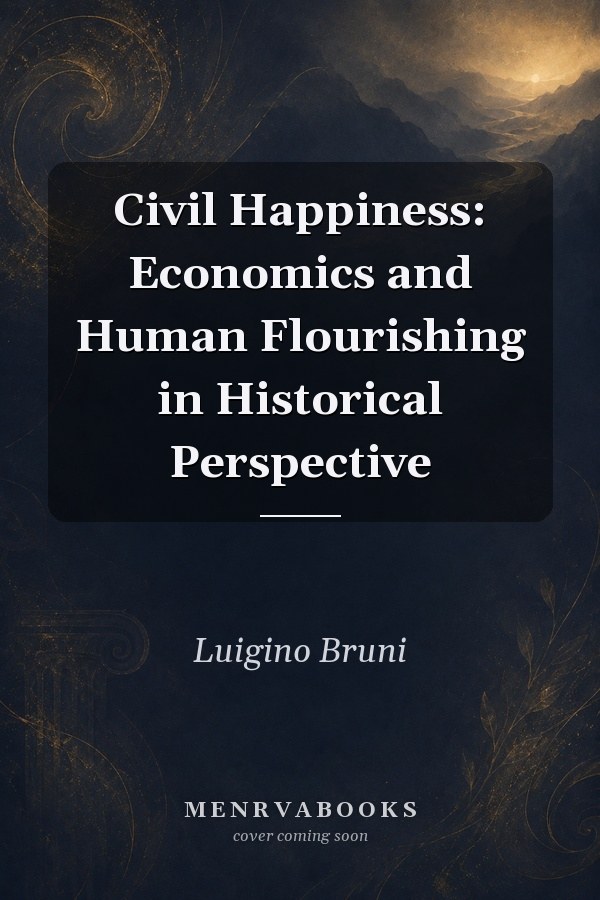
Civil Happiness: Economics and Human Flourishing in Historical Perspective
0
0
As an Amazon Associate and affiliate partner, Menrva Books earns from qualifying purchases. Learn more
Author Description
Economists have long laboured under the misapprehension that all humans exist as rational beings that find happiness in maximizing their personal utility. This impressive volume presents an historical review of the evolution of economic thought, from economic philosophy to contemporary mathematical economics, and its critique of how the human and social dimensions of economics have been lost in this evolutionary process. Examining the crucial period in the late eighteenth century when economists such Smith and Genovesi tried to reconcile the classical tradition of Civil humanism emerging commercial society, this key book analyses the impact that the hedonist approach to economics had in removing the ethical conception of happiness. In addition, it focuses on the impact that J.S. Mill, Wicksteed and Pareto had in shifting methodological thinking away from an emphasis on civil happiness. Simply put, this book is essential reading for economists everywhere.
Menrva's Summary
THE THESIS
How did the transition from classical civil humanism to modern mathematical economics strip the ethical and social dimensions from the concept of human happiness? Luigino Bruni, a scholar of economic history and philosophy, investigates the historical trajectory of economic thought to challenge the prevailing assumption that humans are purely rational utility-maximizers. By tracing the evolution of economic theory from the eighteenth century to the present, the author argues that the shift toward hedonistic models fundamentally altered the discipline's understanding of well-being.
THE SCOPE MAP
What You Will Find
- Historical analysis of the transition from classical civil humanism to contemporary mathematical economics.
- Examination of the contributions and shifts in thought by figures such as Adam Smith, Antonio Genovesi, J.S. Mill, Philip Wicksteed, and Vilfredo Pareto.
- Critical evaluation of the methodological move away from ethical conceptions of happiness.
- Synthesis of economic philosophy and its impact on modern social dimensions.
THE AUTHORITY PERSPECTIVE
Experts and academics recognize this work as a significant contribution to the history of economic thought, particularly for its critique of modern utility theory. Readers frequently note the dense, scholarly nature of the prose, which serves as a rigorous examination of the philosophical foundations underlying current economic models.
Page Count:
192
Publication Date:
2006-01-01
Publisher:
Taylor & Francis Group
ISBN-10:
0203488113
ISBN-13:
9780203488119
Economics
Philosophy
Economic History
Social Science
Community Tags
Similar Books