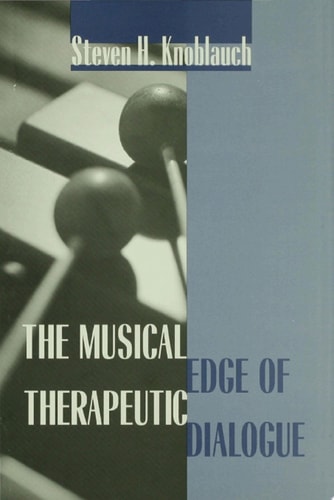
The Musical Edge of Therapeutic Dialogue
0
0
As an Amazon Associate and affiliate partner, Menrva Books earns from qualifying purchases. Learn more
Author Description
In The Musical Edge of Therapeutic Dialogue, Knoblauch provides a model of "resonant minding" in which the musical elements of speech become a major source of information about unconscious communication and action. More specifically, resonant minding, by distinguishing between discrete and continuous levels of communication, between the verbal and the musical, offers a way of accessing and affecting levels of unconscious interactive process by attending to the musical edge of dialogue - provided only we can hear it. Ultimately, Knoblauch argues, the music of therapy is not only another road to the unconscious, but one uniquely able to convey emergent meanings in a variety of domains, from conflicting cultural identifications to the experience of the body to the emergence of desire.
Menrva's Summary
THE THESIS
How can the non-verbal, musical qualities of speech serve as a primary diagnostic and therapeutic tool for accessing unconscious communication? Steven H. Knoblauch, a seasoned psychoanalyst, proposes a model of "resonant minding" that prioritizes the prosodic and rhythmic elements of dialogue over purely verbal content. By integrating clinical observation with communication theory, he argues that the "musical edge" of speech provides a direct pathway to emergent meanings, bodily experiences, and complex cultural identifications that remain inaccessible through traditional linguistic analysis.
THE SCOPE MAP
What You Will Find
- A theoretical framework distinguishing between discrete verbal communication and continuous musical communication.
- Clinical methodology for identifying and utilizing "resonant minding" within the therapeutic session.
- Analysis of how musical elements convey unconscious processes, desire, and cultural conflict.
- Exploration of the intersection between somatic experience and verbal interaction.
THE AUTHORITY PERSPECTIVE
Clinicians and psychoanalytic scholars frequently cite this work as a significant contribution to the study of non-verbal communication in clinical settings. Experts highlight the text's academic density, noting that it provides a sophisticated, nuanced approach for practitioners looking to expand their listening skills beyond the literal word.
Page Count:
0
Publication Date:
2013-01-01
Publisher:
Taylor & Francis Group
ISBN-10:
0203779886
ISBN-13:
9780203779880
Psychology
Therapy
Psychotherapist and patient
Psychoanalysis
Music therapy
Communication