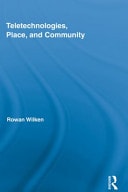
Teletechnologies, Place, and Community
Author Description
Teletechnologies, or technologies of distance, cannot be ignored. Indeed, the present electronic age is said to have wrought profound changes to how we think about and experience who we are, where we are, and how we relate with one another. Place and community have traditionally formed key concepts for thinking about these issues, but what relevance do these concepts now hold for us? In this wide-ranging study, Wilken re-evaluates how ideas of place and community intersect with and help us make sense of a world transformed by information and communication technologies. This interdisciplinary investigation ranges across diverse textual and contextual terrain, exploring approaches from media and communications, architectural history and theory, philosophy, sociology, geography, literature, and urban design. The rich analysis of these myriad texts reveals the complex and at times contradictory ways in which notions of place and community circulate in relation to these technologies of distance. Wilken examination underscores both the enduring importance of ideas of place and community in the present age, and the urgent need to continue to engage with, think about and reconfigure these twin ideas
Menrva's Summary
THE THESIS
This book investigates how the concepts of place and community remain relevant in an era defined by teletechnologies and electronic communication. Rowan Wilken, a scholar in media and communications, synthesizes perspectives from architectural theory, philosophy, and sociology to examine the intersection of physical location and digital connectivity. The work argues that despite the transformative nature of distance-bridging technologies, the human need for place and community persists as a central, albeit reconfigured, aspect of modern existence.
THE SCOPE MAP
What You Will Find
- Interdisciplinary analysis spanning media studies, architectural history, and urban design.
- Theoretical frameworks for understanding the relationship between physical space and digital distance.
- Examination of diverse textual and contextual sources to map shifting social perceptions.
- A critical evaluation of how information technologies influence human interaction and spatial identity.
THE AUTHORITY PERSPECTIVE
Scholars and students of media geography frequently cite this work for its broad interdisciplinary approach to the digital age. The text is recognized for its academic rigor and its ability to synthesize complex theoretical debates into a coherent study of contemporary social structures.
Page Count:
260
Publication Date:
2014-01-01
Publisher:
Taylor & Francis Group
ISBN-10:
0203807022
ISBN-13:
9780203807026
Philosophy
Telecommunications Technology
Telematics
Communication Studies
Social Science
Sociology
Computer Networks
Architecture and technology
Urban Design
Technology & Engineering
Geography
Cyberespace
Communication Technology
Technology
Aspect social
Social Aspects
Cyberspace
Telecommunications
Community Tags
Similar Books