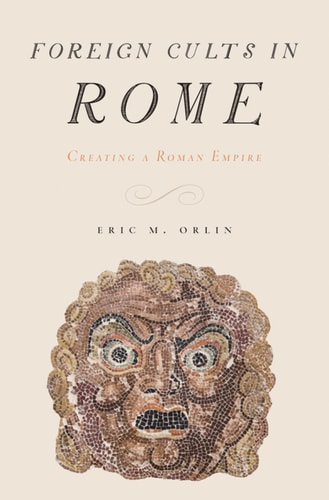
Foreign Cults in Rome: Creating a Roman Empire
0
0
As an Amazon Associate and affiliate partner, Menrva Books earns from qualifying purchases. Learn more
Author Description
Religion is a particularly useful field within which to study Roman self-definition, for the Romans considered themselves to be the most religious of all peoples and ascribed their imperial success to their religiosity. This study builds on the observation that the Romans were remarkably open to outside influences to explore how installing foreign religious elements as part of their own religious system affected their notions of what it meant to be Roman. The inclusion of so many foreign elements posed difficulties for defining a sense of Romanness at the very moment when a territorial definition was becoming obsolete. Using models drawn from anthropology, this book demonstrates that Roman religious activity beginning in the middle Republic (early third century B.C.E.) contributed to redrawing the boundaries of Romanness. The methods by which the Romans absorbed cults and priests and their development of practices in regard to expiations and the celebration of ludi allowed them to recreate a clear sense of identity, one that could include the peoples they had conquered. While this identity faced further challenges during the civil wars of the Late Republic, the book suggests that Roman openness remained a vital part of their religious behavior during this time. Foreign Cults in Rome concludes with a brief look at the reforms of the first emperor Augustus, whose activity can be understood in light of Republican activity, and whose actions laid the foundation for further adaptation under the Empire.
Menrva's Summary
THE THESIS
How did the Roman integration of foreign religious cults function as a mechanism for defining and expanding the concept of Roman identity? Eric Orlin, a scholar of Roman history, utilizes anthropological models to analyze the intersection of religious practice and imperial expansion. The text argues that the Roman state's willingness to incorporate external deities and rituals was not merely a passive act of tolerance, but a deliberate strategy to redefine citizenship and belonging during the middle Republic. By examining the evolution of expiatory rites and public games, the author demonstrates how religious assimilation provided a framework for managing the social complexities of a growing empire.
THE SCOPE MAP
What You Will Find
- Analysis of Roman religious practices from the early third century B.C.E. through the Augustan reforms.
- Application of anthropological frameworks to historical religious data.
- Examination of specific state-sanctioned rituals including ludi and expiations.
Scope Limits
- The study focuses primarily on the Republican period and does not provide an exhaustive history of religious life in the later Imperial centuries.
- The analysis is centered on state-level religious policy rather than the private, domestic religious practices of individual Roman citizens.
THE AUTHORITY PERSPECTIVE
Scholars and students of Roman history frequently cite this work for its clear application of social theory to the study of ancient religious institutions. The text is recognized as a significant contribution to understanding how the Roman state maintained social cohesion through religious adaptation.
Page Count:
260
Publication Date:
2010-01-01
Publisher:
Oxford University Press
ISBN-10:
019045346X
ISBN-13:
9780190453466
Religion
History
Ancient History
Rome religion
Sociology
Ancient - Rome
Community Tags
Similar Books