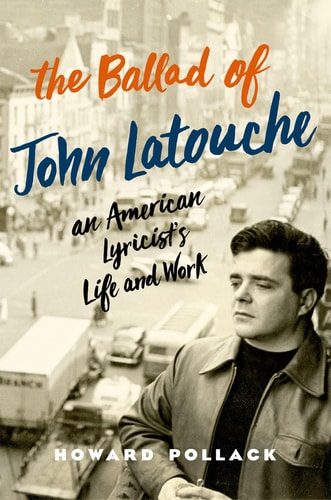
The Ballad of John Latouche: An American Lyricist's Life and Work
0
0
As an Amazon Associate and affiliate partner, Menrva Books earns from qualifying purchases. Learn more
Author Description
Born into a poor Virginian family, John Treville Latouche (1914-56), in his short life, made a profound mark on America's musical theater as a lyricist, book writer, and librettist. The wit and skill of his lyrics elicited comparisons with the likes of Ira Gershwin, Lorenz Hart, and Cole Porter, but he had too, noted Stephen Sondheim, "a large vision of what musical theater could be," and he proved especially venturesome in helping to develop a lyric theater that innovatively combined music, word, dance, and costume and set design. Many of his pieces, even if not commonly known today, remain high points in the history of American musical theater."A great American genius" in the words of Duke Ellington, Latouche initially came to wide public attention in his early twenties with his cantata for soloist and chorus, Ballad for Americans (1939), with music by Earl Robinson-a work that swept the nation during the Second World War. Other milestones in his career included the all-black musical fable, Cabin in the Sky (1940), with Vernon Duke; an interracial updating of John Gay's classic, The Beggar's Opera, as Beggar's Holiday (1946), with Duke Ellington; two acclaimed Broadway operas with Jerome Moross: Ballet Ballads (1948) and The Golden Apple (1954); one of the most enduring operas in the American canon, The Ballad of Baby Doe (1956), with Douglas Moore; and the operetta Candide (1956), with Leonard Bernstein and Lillian Hellman. Extremely versatile, he also wrote cabaret songs, participated in documentary and avant-garde film, translated poetry, adapted plays, and much else.Meanwhile, as one of Manhattan's most celebrated raconteurs and hosts, he developed a wide range of friends in the arts, including, to name only a few, Paul and Jane Bowles (whom he introduced to each other), Yul Brynner, John Cage, Jack Kerouac, Frederick Kiesler, Carson McCullers, Frank O'Hara, Dawn Powell, Ned Rorem, Virgil Thomson, Gore Vidal, and Tennessee Williams-a dazzling constellation of
Menrva's Summary
THE THESIS
This biography investigates the life and creative contributions of John Treville Latouche, a pivotal yet often overlooked figure in the development of 20th-century American musical theater. Howard Pollack, a musicologist and professor, utilizes extensive archival research, personal correspondence, and primary source documents to reconstruct Latouche's career. The book argues that Latouche's innovative approach to integrating music, dance, and design significantly expanded the boundaries of the American lyric theater.
THE SCOPE MAP
What You Will Find
- A comprehensive chronological account of Latouche's major works, including Ballad for Americans, Cabin in the Sky, and The Ballad of Baby Doe.
- Analysis of Latouche's collaborations with figures such as Duke Ellington, Leonard Bernstein, and Douglas Moore.
- Documentation of Latouche's social circle and his role as a central figure in the mid-century Manhattan arts scene.
Scope Limits
- The text focuses primarily on professional output and public life, with less emphasis on private psychological introspection.
- It does not provide a complete musical score analysis for every minor composition mentioned.
THE AUTHORITY PERSPECTIVE
Experts recognize this work as a definitive scholarly resource that restores Latouche to his rightful place in the American musical canon. Readers frequently note the meticulous detail and academic rigor Pollack brings to the subject, making it a standard reference for theater historians.
Page Count:
590
Publication Date:
2017-11-02
Publisher:
Oxford University Press
ISBN-10:
0190458291
ISBN-13:
9780190458294
Biography
Music History
Theater History
Composers
Librettists
American History
Humanities
Lyricists
Community Tags
Other Editions(2)
Similar Books



Reader Comments
Share Your Thoughts
No comments yet. Be the first to share your thoughts!