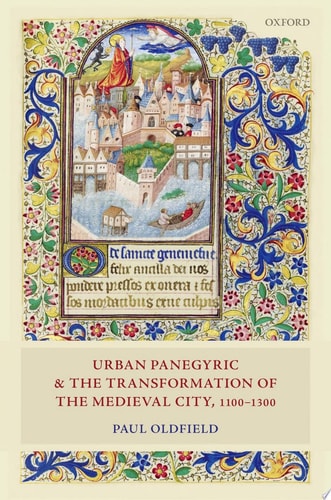
Urban Panegyric and the Transformation of the Medieval City, 1100-1300
0
0
As an Amazon Associate and affiliate partner, Menrva Books earns from qualifying purchases. Learn more
Author Description
This study offers the first extensive analysis of the function and significance of urban panegyric in the Central Middle Ages, a flexible literary genre which enjoyed a marked and renewed popularity in the period 1100 to 1300. In doing so, it connects the production of urban panegyric to major underlying transformations in the medieval city and explores praise of cities primarily in England, Flanders, France, Germany, Iberia, and Italy (including the South and Sicily). The volume demonstrates how laudatory ideas on the city appeared in extremely diverse textual formats which had the potential to interact with a wide audience via multiple textual and material sources. When contextualized within the developments of the twelfth and thirteenth centuries these ideas could reflect more than formulaic, rhetorical outputs for an educated elite, they were instead integral to the process of urbanisation. In Urban Panegyric and the Transformation of the Medieval City, 1100-1300, Paul Oldfield assesses the generation of ideas on the Holy City, on counter-narratives associated with the Evil City, on the inter-relationship between the City and abundance (primarily through discourses on commercial productivity, hinterlands and population size), on landscapes and sites of power, and on knowledge generation and the construction of urban histories. Urban panegyric can enable us to comprehend more deeply material, functional, and ideological change associated with the city during a period of notable urbanization, and, importantly, how this change might have been experienced by contemporaries. This study therefore highlights the importance of urban panegyric as a product of, and witness to, a period of substantial urban change. In examining the laudatory depiction of medieval cities in a thematic analysis it can contribute to a deeper understanding of civic identity and its important connection to urban transformation.
Menrva's Summary
THE THESIS
This study investigates the function and significance of urban panegyric as a literary genre and its role in reflecting the socio-economic transformations of the medieval city between 1100 and 1300. Paul Oldfield, a scholar of medieval history, utilizes a thematic analysis of diverse textual formats to argue that praise of cities was not merely rhetorical, but a vital component of the urbanization process. By examining how these texts articulated civic identity, he demonstrates that panegyric served as both a product of and a witness to the material and ideological shifts occurring across Europe during the Central Middle Ages.
THE SCOPE MAP
What You Will Find
- Analysis of urban panegyric across England, Flanders, France, Germany, Iberia, and Italy.
- Examination of thematic discourses including the Holy City, the Evil City, commercial productivity, and landscapes of power.
- Exploration of how laudatory texts functioned as tools for constructing urban histories and civic identity.
Scope Limits
- The study focuses primarily on the period between 1100 and 1300.
- It does not provide an exhaustive catalog of every extant panegyric text but rather a thematic assessment of the genre's function.
THE AUTHORITY PERSPECTIVE
Scholars recognize this work as a significant contribution to the study of medieval urbanism and the intersection of literature and social history. Readers frequently note the academic density of the prose and the breadth of the geographical scope, which provides a comprehensive framework for understanding civic identity in the Central Middle Ages.
Page Count:
224
Publication Date:
2018-01-01
Publisher:
OUP Oxford
ISBN-10:
0191027537
ISBN-13:
9780191027536
History
In literature
European History
Literary Criticism
Urban Studies
Cities And Towns
Cultural History
Community Tags
Similar Books